 Your design here
Design it right now
Classic Tee — with YOUR design on it
Upload art, type text, or let the AI design it — live preview, no minimums, pay over time, ships in 5–9 days.
Split eligible US orders into 4 interest-free payments with Shop Pay
🎨 Put my design on this →Gildan 5000 · 100% cotton · 5.0–5.3 oz/yd² (170-180 g/m²) · blank sourced from Honduras · printed in the USA network · ships 5–9 days
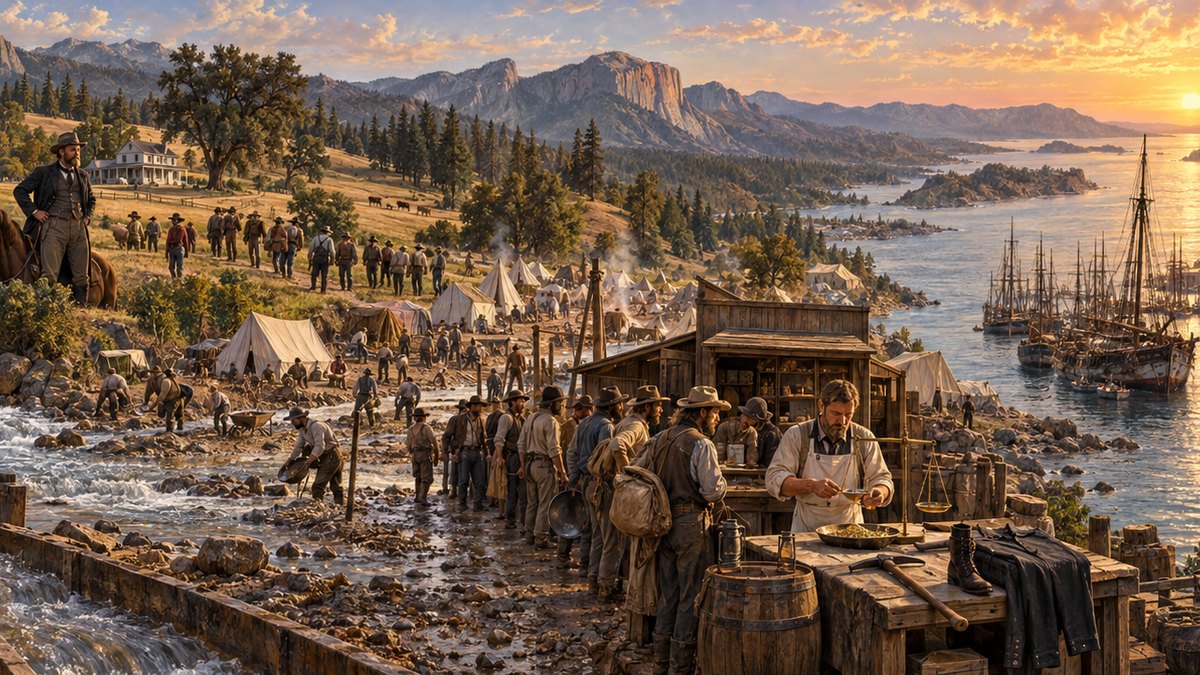
The California Gold Rush created fortunes, but not necessarily for the people standing closest to the first gold. James Marshall found it. John Sutter owned the mill project. Both watched the discovery transform California while making their own lives far more complicated.
The five things
James Marshall never turned his discovery into a fortune
California State Parks records that Marshall found gold in the tailrace of Sutter’s sawmill at Coloma on January 24, 1848. He later owned small mining interests and worked as a blacksmith but struggled financially. California eventually granted him a temporary state pension beginning in 1872. He died in 1885, and the state later erected a monument over his grave overlooking the discovery site.
John Sutter’s empire was damaged by the rush
The National Park Service says Sutter had hoped to build an agricultural empire around New Helvetia. Once news of gold escaped, workers deserted, newcomers flooded his lands, and squatters challenged his property claims. California State Parks records that Sutter eventually left his California venture and spent later years seeking compensation from Congress for lands he believed had been taken from him during the upheaval.
Merchants often found steadier money than miners
California State Parks notes that outfitters and merchants prospered by supplying the mining population. Levi Strauss is a famous later example. His company history says he arrived in San Francisco in 1853 and opened a wholesale dry-goods business serving Western stores. The riveted work pants associated with his later fortune did not arrive until 1873, so the simple story that he immediately sold miners blue jeans is incorrect.
San Francisco filled with ships that could not find crews
The National Park Service says more than 800 ships crowded Yerba Buena Cove by 1851, and many had been abandoned when sailors left for the gold fields. Some hulls were reused as warehouses, hotels, shops, and foundations as the waterfront expanded. Archaeologists now believe dozens of Gold Rush vessels remain beneath modern San Francisco, making pieces of the old harbor part of the city’s buried landscape.
Gold remains, but nobody can honestly count “most” of it
California continued producing gold long after the first rush, and mining persisted at some historic districts into the twentieth century. The U.S. Geological Survey still identifies gold resources in California, but the claim that “most” original gold remains underground cannot be measured with confidence. Gold may exist too deep, too dispersed, environmentally restricted, or too expensive to recover, which is different from a known pile waiting to be mined.
Where this story comes from
The broad history appears in the Wikipedia article “California Gold Rush.” A valuable primary source is James Marshall’s own account of discovering the metal at Sutter’s Mill. Contemporary diaries, letters, newspapers, shipping records, and the New Helvetia diary also preserve how quickly news moved and how California changed once people realized the discovery was genuine.
Why a shirt company tells this story
The Gold Rush belongs to California families, history teachers, miners, geologists, travelers, entrepreneurs, and people fascinated by what happens when an entire economy starts chasing one opportunity. A design might use a pan, an 1848 map, an abandoned ship, a pick, or the outline of the Sierra foothills. It can be printed or embroidered on one shirt with no minimum. The best wearable version of the Gold Rush is not just gold itself, but the strange human stories around who found it and who actually profited.
Watch it on YouTube: 5 Things Nobody Tells You About The Gold Rush. Subscribe to GoatNut for the next one.
Frequently asked questions
Who first discovered gold in the California Gold Rush?
James W. Marshall found gold at Sutter's Mill in Coloma on January 24, 1848. Other gold discoveries had occurred in California earlier, but Marshall's find triggered the rush that transformed the state.
Did Levi Strauss get rich mining gold?
No. Levi Strauss built a dry-goods business serving Western merchants after arriving in San Francisco in 1853. His company later partnered with tailor Jacob Davis to patent riveted work pants in 1873.
Are Gold Rush ships really buried under San Francisco?
Yes. Many abandoned vessels were incorporated into the expanding waterfront or buried beneath landfill and construction. The National Park Service estimates that roughly 40 to 60 historic ships remain beneath downtown San Francisco.
Or start with the art: free AI design tool + all free tools →