

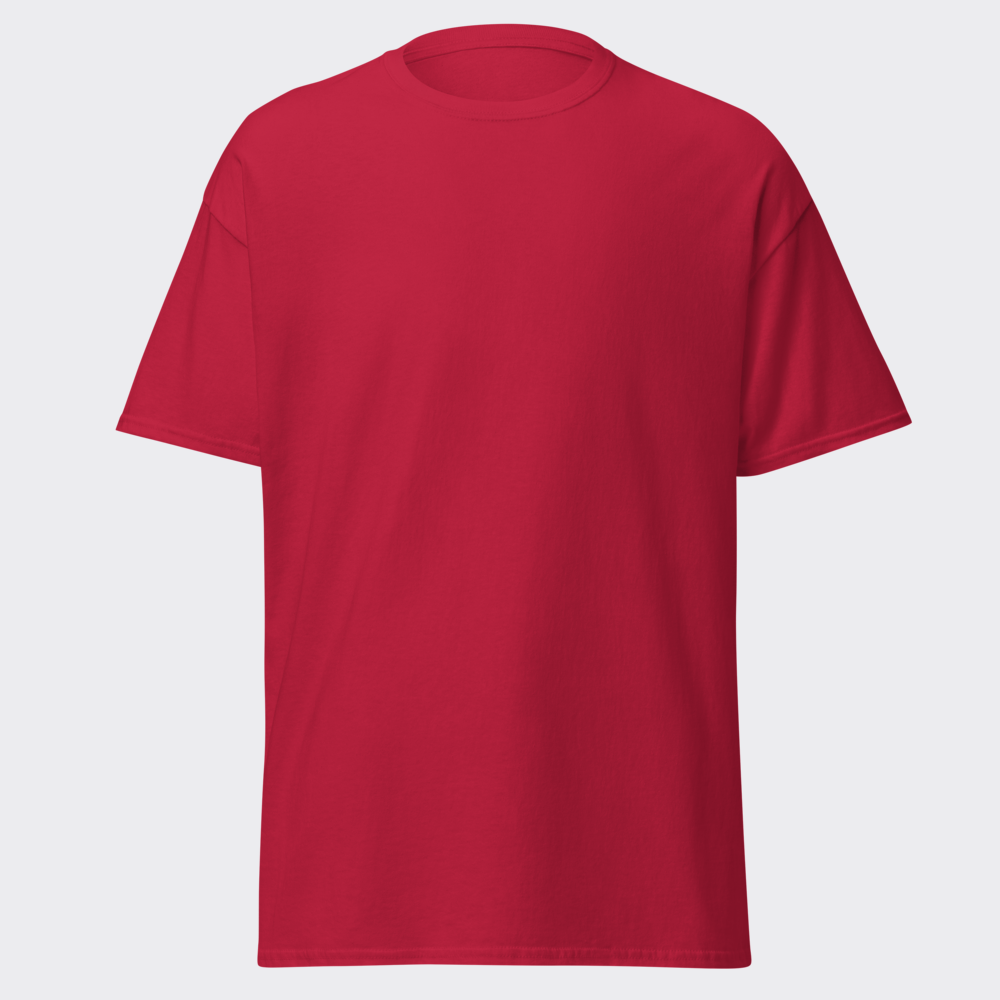
 Your design here
Design it right now
Classic Tee — with YOUR design on it
Upload art, type text, or let the AI design it — live preview, no minimums, pay over time, ships in 5–9 days.
Split eligible US orders into 4 interest-free payments with Shop Pay
🎨 Put my design on this →Gildan 5000 · 100% cotton · 5.0–5.3 oz/yd² (170-180 g/m²) · blank sourced from Honduras · printed in the USA network · ships 5–9 days
You can calculate a spirit wear fundraiser's exact profit before committing because the bulk tiers are published - twenty percent off at twenty of the same item, twenty-five at fifty, thirty at two hundred. Ready to start? custom school uniforms.
How do you calculate the raise?
Take your cost at the tier your volume lands in, subtract it from your sale price, and multiply by units. On a twenty-five dollar tee at the fifty-piece tier the cost is eighteen seventy-five, so selling at thirty raises eleven twenty-five per shirt - five hundred and sixty-two fifty across fifty. No quote form is needed because nothing about that number is negotiated.
Should you take orders first or produce first?
Take orders first, always. Producing first means guessing demand and sizes and financing both. Taking orders first means you produce exactly what sold, the fundraiser cannot lose money, and nobody is left holding unsold smalls. With no minimum and a five to nine day window, there is no operational reason to do it the other way.
What actually caps the raise?
Price sensitivity, not cost. A school community will usually pay a normal retail price for a hoodie they want to wear and will not pay a premium for a tee they were talked into. Spend the design effort on making it something students would choose, and the volume takes care of the margin.
Real numbers on a $25 tee sold at $30
- 20 sold - cost $20 each, raises $10 each, $200 total
- 50 sold - cost $18.75 each, raises $11.25 each, $562.50 total
- 200 sold - cost $17.50 each, raises $12.50 each, $2,500 total
- Hoodies - higher cost, higher price, usually the better raise per unit
How long does it take to arrive?
Every order is made to order and ships in five to nine business days, and that window covers a single piece and a two-hundred-piece run alike - there is no separate multi-week queue for larger orders. Our fastest verified US delivery was three days on real carrier tracking, and our fastest verified international delivery was Latvia to New York in five days. For an event, order about two weeks ahead so there is room to check the first piece and distribute sizes.
Is there really no minimum order?
None. One piece is a real order at normal pricing with no small-order surcharge. Traditional printers set minimums because screen printing and machine embroidery both carry a fixed per-job setup cost that has to be spread across enough pieces to be worth doing. Print-on-demand production has no per-job setup, so the reason for the minimum simply does not exist - which is why ordering one to check it before committing the budget is the standard advice here.
Where to go next
Order at least two weeks before the event so the 5-9 day window lands with room to sort sizes. See how to avoid the size guess entirely. Schools that need the order placed before the funds arrive can look at zero down school uniforms.
See the merch in real life
Real garments, printed and embroidered to order.
Frequently asked questions
How do I calculate a fundraiser's profit?
Cost at your tier subtracted from sale price, multiplied by units. Tiers are published so nothing is negotiated.
Should we take orders before producing?
Yes, always. You produce exactly what sold and the fundraiser cannot lose money.
What are the tiers?
20% off at 20+ of the same item, 25% at 50+, 30% at 200+.
What raises more, tees or hoodies?
Hoodies usually, on a per-unit basis, because the higher price carries a bigger spread.
How far ahead should we order?
At least two weeks before the event.
Is there a minimum?
No minimum, and every size prints to order.
Or start with the art: free AI design tool + all free tools →


