 Your design here
Design it right now
Classic Tee — with YOUR design on it
Upload art, type text, or let the AI design it — live preview, no minimums, pay over time, ships in 5–9 days.
Split eligible US orders into 4 interest-free payments with Shop Pay
🎨 Put my design on this →Gildan 5000 · 100% cotton · 5.0–5.3 oz/yd² (170-180 g/m²) · blank sourced from Honduras · printed in the USA network · ships 5–9 days
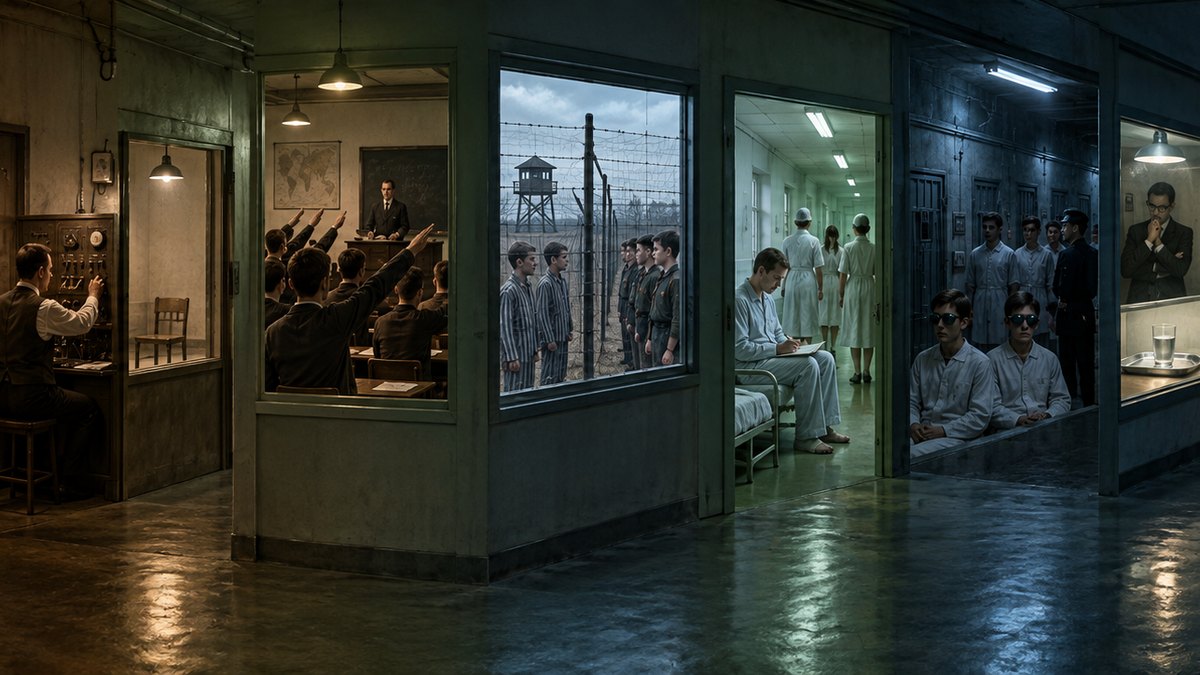
Some famous psychology studies are remembered because they produced striking results. Others are remembered because of what researchers were willing to do to get them. Modern research ethics grew partly from cases where consent, deception, risk, or the right to leave were treated very differently than they would be today.
What the video covers
Little Albert and the Monster Study used children
Johns Hopkins historians describe the 1920 Little Albert experiment as an attempt to condition fear in an infant by pairing a white rat with a frightening noise. There is no clear evidence that researchers later removed the learned fear. In 1939, Wendell Johnson’s Iowa team studied speech in children at an orphanage. University of Iowa records later acknowledged serious ethical problems in labeling and criticizing children’s speech.
Milgram and the Third Wave tested obedience
Stanley Milgram reported in 1963 that 65 percent of participants in his best-known condition continued to the maximum labeled 450-volt shock when urged by an experimenter, although no real shocks were delivered. In 1967, California teacher Ron Jones created the classroom exercise later called the Third Wave. Jones said the rapidly growing discipline-and-conformity exercise became alarming enough that he ended it after several days.
Robbers Cave and Rosenhan manipulated social reality
Muzafer Sherif’s Robbers Cave study divided boys at an Oklahoma camp into groups, encouraged competition, and then tested ways to reduce hostility through shared goals. Nearly two decades later, psychologist David Rosenhan reported that eight healthy people gained admission to psychiatric hospitals after reporting a single symptom. His 1973 Science paper argued that staff struggled to distinguish sanity from illness within institutional settings.
Stanford Prison and MKULTRA became warnings
The Stanford Prison Experiment ended after six days in 1971, much earlier than planned, after serious distress and abusive behavior developed. Later scholarship has challenged how spontaneous some guard behavior really was. CIA records on MKULTRA are less ambiguous about consent: congressional investigations found that some people were secretly given LSD and other substances without knowing they were research subjects.
Tuskegee and the social media experiment changed the debate
The CDC says the Tuskegee study enrolled 600 Black men, including 399 with syphilis, without informed consent and withheld available treatment even after penicillin became standard. Decades later, a 2014 PNAS paper reported that researchers altered emotional content shown in the News Feeds of 689,003 users. That study was legally different, but it triggered a major debate about consent in large-scale digital research.
Where this story comes from
The broad context is covered in the Wikipedia article “Human subject research.” One key primary source is Stanley Milgram’s 1963 paper “Behavioral Study of Obedience,” which reports his procedure and results in his own words. Other cases are best checked against their original papers, government files, and later institutional records because popular retellings often simplify what actually happened.
Why a shirt company tells this story
These stories matter to psychology students, teachers, researchers, ethics classes, medical professionals, and people interested in how rules change after institutions get things wrong. A design could use a laboratory diagram, old questionnaire style, simple brain imagery, or a research-ethics theme without making suffering into a joke. It can be printed or embroidered on one shirt with no minimum. Sometimes what you wear can point to a field you study and the lessons that field had to learn.
Watch it on YouTube: 10 Human Experiments That Would Never Be Allowed Today. Subscribe to GoatNut for the next one.
Frequently asked questions
What makes a human experiment unethical?
Major concerns include missing informed consent, unnecessary harm, coercion, deceptive risks, unfair subject selection, lack of independent review, and preventing participants from leaving. Modern research rules require stronger protections than many historical studies provided.
Did Milgram participants really give lethal electric shocks?
No real shocks were delivered. Participants were led to believe they were administering increasingly powerful shocks to another person. In Milgram's best-known condition, 65 percent continued to the maximum switch labeled 450 volts.
Why was the Tuskegee study unethical?
Participants did not give informed consent and were misled about the study. Men with syphilis were not offered effective treatment after penicillin became standard, allowing researchers to continue observing untreated disease for decades.
Or start with the art: free AI design tool + all free tools →