 Your design here
Design it right now
Classic Tee — with YOUR design on it
Upload art, type text, or let the AI design it — live preview, no minimums, pay over time, ships in 5–9 days.
Split eligible US orders into 4 interest-free payments with Shop Pay
🎨 Put my design on this →Gildan 5000 · 100% cotton · 5.0–5.3 oz/yd² (170-180 g/m²) · blank sourced from Honduras · printed in the USA network · ships 5–9 days
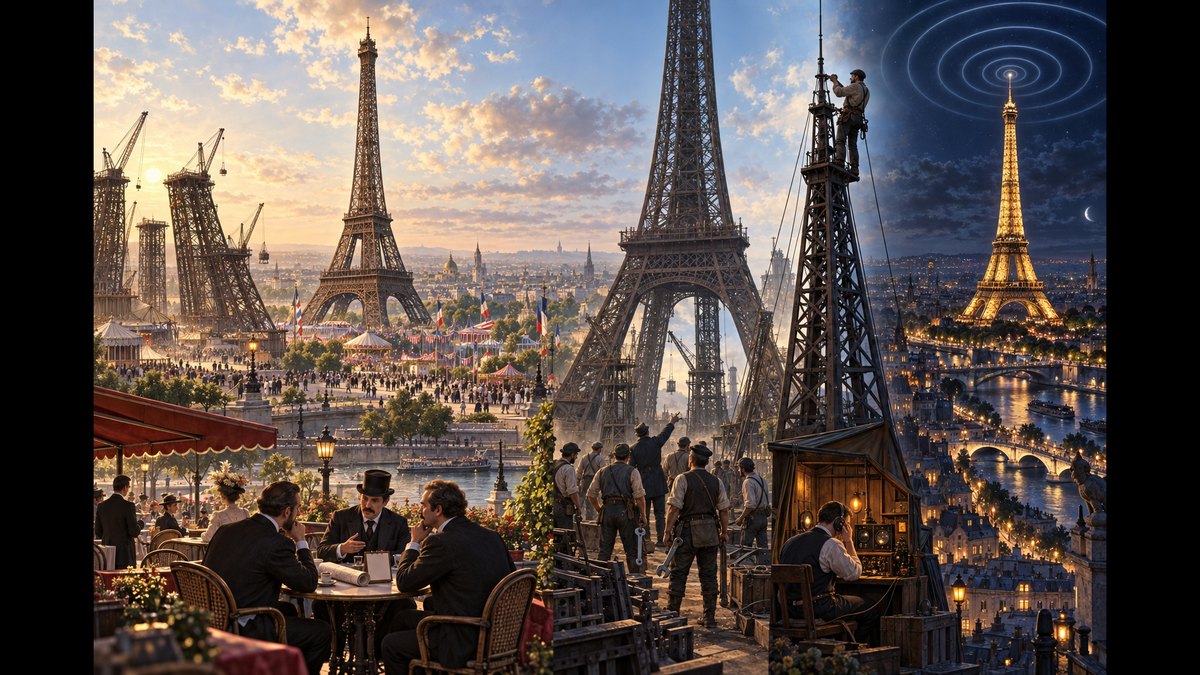
The Eiffel Tower survived because it learned how to be useful. Paris built it for a world's fair, critics attacked it, and its original arrangement was temporary. Then engineers discovered that 300 meters of iron made a very good place for an antenna.
What the video covers
It began as a world's fair centerpiece
The official Eiffel Tower history says the structure was created for the 1889 Exposition Universelle, held during the centenary year of the French Revolution. More than one hundred proposals were considered in the competition connected with the fair. Eiffel's company developed a tower whose exposed iron structure was not disguised as stone architecture, which made it look radically different from the Paris around it.
Some famous artists publicly attacked it
The Bibliothèque nationale de France preserves the cultural history around the 1887 artists' protest against the tower. Writers, painters, architects, and composers described the project as an ugly industrial intrusion into Paris. The signatories included major cultural figures. Their objections are useful because today's beloved landmark was not universally welcomed as beautiful, tasteful, or even appropriate when construction began.
The original arrangement had an expiration date
The Eiffel Tower's official site explains that Gustave Eiffel received a 20-year concession connected with use of the site. By 1910 the arrangement would expire and demolition was a real possibility. Eiffel understood the risk early. He encouraged meteorology, aerodynamics, astronomy, physics, and other experiments because a scientific instrument had a stronger argument for survival than a fairground attraction whose main event had ended.
Radio gave the tower a new job
According to the official Eiffel Tower history, Eugène Ducretet made wireless transmissions between the tower and the Panthéon in 1898. Gustave Ferrié later developed military radio experiments there. By 1908 signals using the tower reached thousands of kilometers. Height had turned the structure into communications infrastructure, giving government officials a practical reason to preserve something that critics had once dismissed as useless iron.
Strategic value secured its future
The Eiffel Tower's official history records that a permanent military radiotelegraph station was established in 1909 and Eiffel's concession was extended for another 70 years beginning in 1910. During World War I the station served French military communications and intelligence needs. The tower did not survive simply because Paris changed its mind about its appearance. Its usefulness bought it the time needed to become beloved.
Where this story comes from
The broad history appears in the Wikipedia article "Eiffel Tower." A primary source is the 1887 convention governing construction, financing, operation, and eventual control of the tower. Another contemporary voice is the artists' protest published in Le Temps in February 1887, which shows how strongly some prominent Parisians opposed the project.
Why a shirt company tells this story
The Eiffel Tower belongs to travelers, engineers, architects, radio enthusiasts, teachers, Francophiles, and anyone who likes stories about things that survived by finding a second purpose. A design might use the iron lattice, early radio equipment, construction geometry, or the Paris skyline. It can be printed or embroidered on one shirt with no minimum. A familiar landmark becomes more interesting when what you wear points to the unexpected reason it is still there.
Watch it on YouTube: 5 Things Nobody Tells You About The Eiffel Tower. Subscribe to GoatNut for the next one.
Frequently asked questions
Was the Eiffel Tower supposed to be temporary?
Yes. The tower was built for the 1889 Exposition Universelle under an arrangement that gave Gustave Eiffel a 20-year operating concession. Its long-term survival was not guaranteed when it opened.
Why was the Eiffel Tower not demolished?
Scientific experiments and especially wireless telegraphy made its height strategically useful. By 1909 it supported a permanent military radio station, and Eiffel's concession was extended instead of the tower being removed.
Did people in Paris hate the Eiffel Tower?
Some prominent artists and writers strongly opposed it and published a famous protest in 1887. Public opinion was never completely uniform, and the tower attracted huge numbers of visitors during the 1889 fair.
Or start with the art: free AI design tool + all free tools →