 Your design here
Design it right now
Classic Tee — with YOUR design on it
Upload art, type text, or let the AI design it — live preview, no minimums, pay over time, ships in 5–9 days.
Split eligible US orders into 4 interest-free payments with Shop Pay
🎨 Put my design on this →Gildan 5000 · 100% cotton · 5.0–5.3 oz/yd² (170-180 g/m²) · blank sourced from Honduras · printed in the USA network · ships 5–9 days
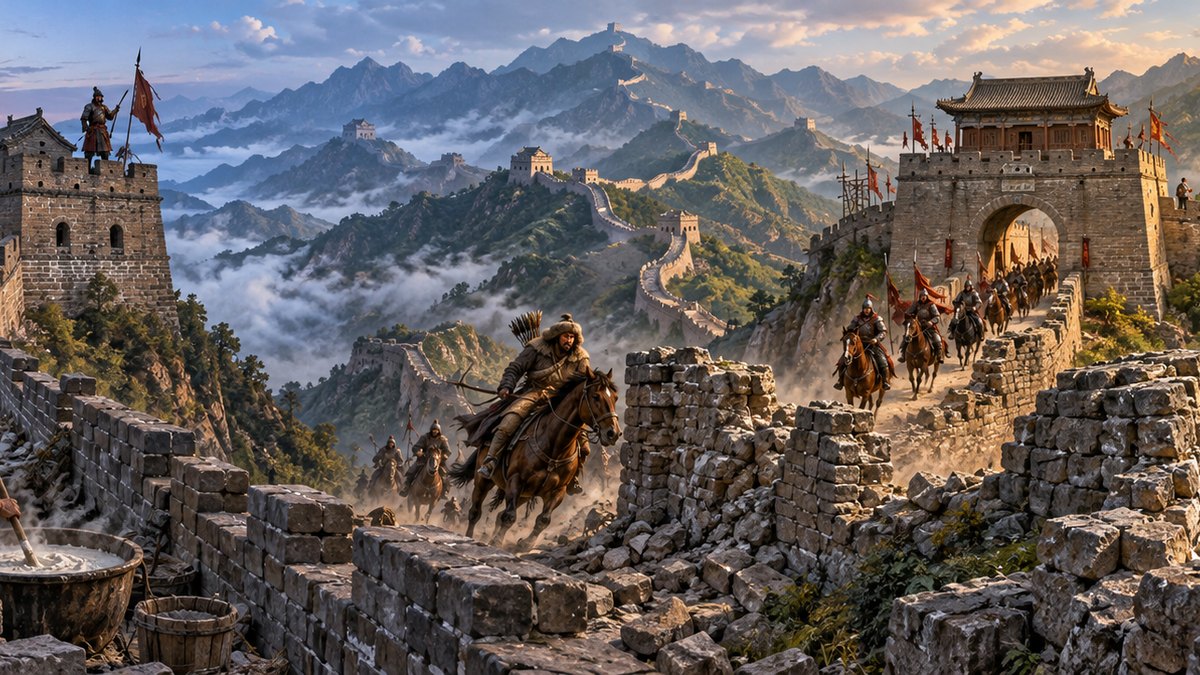
The Great Wall looks like one giant idea drawn across a map. In reality, it is a patchwork of walls, forts, passes, roads, and repairs built by different governments for very different problems.
The five things
It is a network, not one unbroken wall
UNESCO describes the Great Wall as a system built from the third century BC to the seventeenth century AD, with walls, watchtowers, shelters, fortresses, and passes. Its listed total length is more than 20,000 kilometers. That helps explain why one photograph can never show what the Great Wall really is. Different sections belong to different eras, landscapes, and military plans.
The space story survived because it sounded believable
NASA says the Great Wall is generally not visible to the unaided eye from low Earth orbit and is certainly not visible from the Moon. The problem is not simply size. The wall is narrow and often similar in color to the ground around it. Astronaut photographs can show sections with powerful lenses, but that is very different from spotting it naturally with human vision.
Sticky rice was a serious building material
According to research highlighted by Smithsonian magazine, some Ming-era builders mixed sticky rice with lime mortar. Scientists identified amylopectin, a starch from rice, in the material. The organic ingredient helped create mortar that resisted water and cracking. It sounds like a kitchen trick, but it was part of a sophisticated construction recipe used on important masonry in imperial China.
The wall controlled movement as much as invasion
According to Smithsonian magazine, checkpoints along the wall also became places where officials could watch trade and smuggling. A wall cannot stop every army, especially across thousands of miles, but gates and passes can shape where people, horses, goods, and taxes move. That made the Great Wall a border system as well as a battlefield obstacle.
Missing wall can still be found in nearby buildings
Smithsonian reports that villagers reused wall bricks for houses and animal pens during long periods when ruined sections had little protection. In some places, the Great Wall did not vanish in one dramatic event. It was dismantled piece by piece and absorbed into ordinary life. Modern preservation laws came after centuries in which local stone and brick were simply useful building material.
Where this story comes from
The broad outline is covered in the Wikipedia article “Great Wall of China.” A useful primary source is Qi Jiguang’s sixteenth-century military writing, including the Jixiao Xinshu, which shows how Ming commanders thought about frontier defense, troops, fortifications, and disciplined military systems during the period when many famous wall sections were strengthened.
Why a shirt company tells this story
People wear the subjects they care about. A history teacher may love the engineering. A traveler may remember standing on a windy ridge outside Beijing. A student may simply like the idea that one famous “wall” is really two thousand years of changing borders. That kind of interest can become a small piece of wearable history, printed or embroidered on one shirt with no minimum, without turning the story into a souvenir-shop slogan.
Watch it on YouTube: 5 Things Nobody Tells You About The Great Wall Of China. Subscribe to GoatNut for the next one.
Frequently asked questions
How old is the Great Wall of China?
Different sections have different ages. Major wall building began more than 2,000 years ago, while many of the best-known brick sections near Beijing were built or rebuilt during the Ming dynasty.
Can the Great Wall of China be seen from space?
Not reliably with the naked eye. NASA says it is generally not visible unaided from low Earth orbit and cannot be seen from the Moon, although cameras with strong lenses can photograph sections.
Why was the Great Wall of China built?
It was built and rebuilt to defend borders, control important passes, watch movement, signal warnings, and manage frontier routes. It was never a single project with one purpose or one builder.
Or start with the art: free AI design tool + all free tools →