 Your design here
Design it right now
Classic Tee — with YOUR design on it
Upload art, type text, or let the AI design it — live preview, no minimums, pay over time, ships in 5–9 days.
Split eligible US orders into 4 interest-free payments with Shop Pay
🎨 Put my design on this →Gildan 5000 · 100% cotton · 5.0–5.3 oz/yd² (170-180 g/m²) · blank sourced from Honduras · printed in the USA network · ships 5–9 days
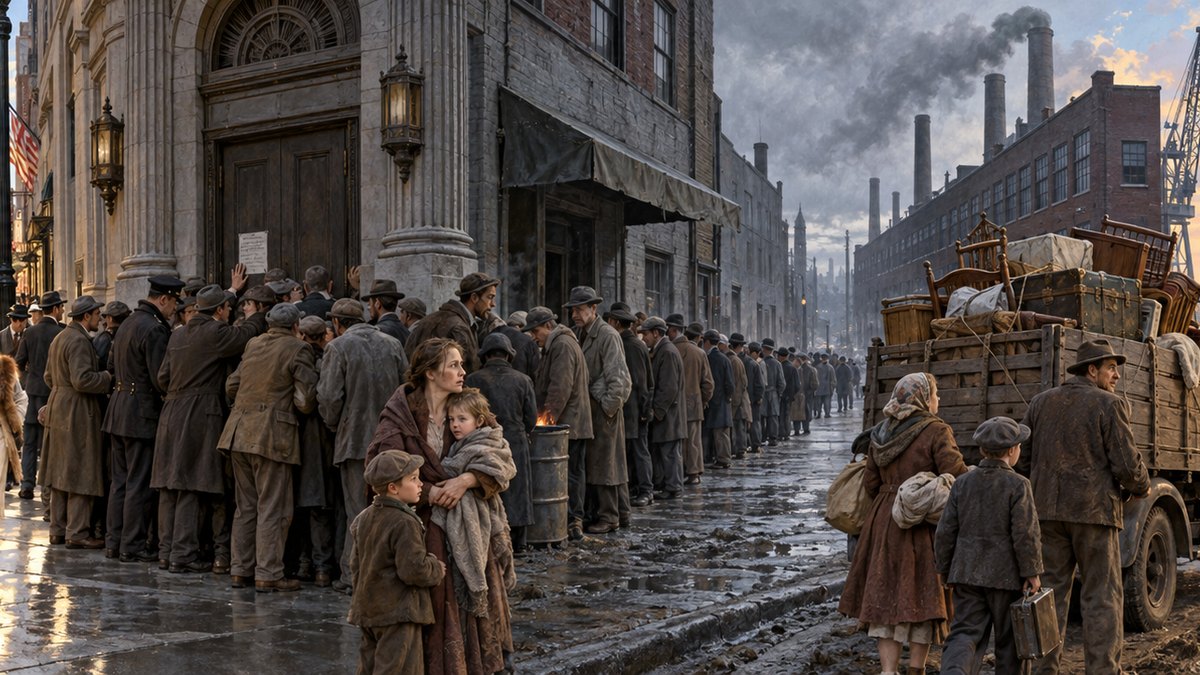
The Great Depression is often reduced to one day on Wall Street. The stock market crash became its most famous image, but the economic contraction had already begun, and the worst banking failures, unemployment, and deflation unfolded over the years that followed.
The five things
The Depression did not begin with one crash
Federal Reserve History dates the beginning of the U.S. economic contraction to August 1929, before the dramatic Wall Street crash in October. The crash damaged confidence and wealth, but it was one part of a larger collapse. Banking panics, falling industrial production, international financial trouble, the gold standard, monetary contraction, and declining demand turned a recession into something much deeper and longer.
Thousands of banks disappeared before federal insurance
The Federal Deposit Insurance Corporation says approximately 9,000 banks suspended operations from 1930 through 1933. National federal deposit insurance did not begin until 1934. Before that, a failed bank could leave ordinary depositors with major losses and no federal guarantee. The crisis became so severe that President Franklin D. Roosevelt declared a nationwide banking holiday shortly after taking office in March 1933.
Unemployment reached levels almost unimaginable today
Historical estimates put U.S. unemployment near one-quarter of the labor force at the Depression’s worst point in 1933. Those who kept jobs were not automatically safe. Hours, wages, and household incomes fell across many industries. The exact decline varied by occupation and location, so the common claim that every employed worker took a one-third wage cut is too simple, but the pressure on earnings was widespread.
Falling prices made existing debts heavier
Federal Reserve History says the U.S. money supply fell by nearly 30 percent from 1930 into 1933, accompanied by severe deflation. Lower prices sound helpful until a farmer, homeowner, or business owes a fixed number of dollars. If income and prices fall while the debt does not, each dollar of repayment becomes harder to earn. Deflation therefore pushed borrowers toward bankruptcy and weakened spending even further.
Recovery began before the war, but full employment came with it
New Deal banking reforms, relief programs, monetary changes, and other policies contributed to substantial recovery after 1933, so saying no government program mattered would be misleading. The economy also suffered another recession in 1937 and 1938. Federal Reserve History places the return to full output and employment during World War II, when enormous defense production and government spending finally absorbed the remaining unemployed workforce.
Where this story comes from
The broad history appears in the Wikipedia article “Great Depression in the United States.” A useful primary source is Franklin D. Roosevelt’s first Fireside Chat on March 12, 1933, when he explained the banking crisis directly to Americans after the national bank holiday. Government statistics, Federal Reserve records, congressional hearings, and bank documents provide the harder numbers behind that public explanation.
Why a shirt company tells this story
The Great Depression matters to economics students, teachers, family historians, bankers, investors, labor-history readers, and anyone trying to understand how financial systems affect ordinary households. A design might use a 1930s storefront, bank ledger, bread-line silhouette, work-program typography, or an economic chart. It can be printed or embroidered on one shirt with no minimum. Wearing history can be a way to remember that economic statistics are never only numbers. They describe what happened to real people’s work, savings, homes, and choices.
Watch it on YouTube: 5 Things Nobody Tells You About The Great Depression. Subscribe to GoatNut for the next one.
Frequently asked questions
Did the 1929 stock market crash cause the Great Depression?
The crash was important, but it was not the only cause. The downturn had already begun, and banking failures, monetary contraction, deflation, international problems, falling demand, and policy mistakes deepened the Depression.
How many banks failed during the Great Depression?
The FDIC says approximately 9,000 banks suspended operations between 1930 and 1933. Federal deposit insurance did not begin until 1934, so many depositors suffered losses when banks failed.
Did World War II end the Great Depression?
The economy had already recovered substantially from its 1933 low, but unemployment remained a problem. Massive wartime production and government spending brought the United States back to full output and employment during World War II.
Or start with the art: free AI design tool + all free tools →