 Your design here
Design it right now
Classic Tee — with YOUR design on it
Upload art, type text, or let the AI design it — live preview, no minimums, pay over time, ships in 5–9 days.
Split eligible US orders into 4 interest-free payments with Shop Pay
🎨 Put my design on this →Gildan 5000 · 100% cotton · 5.0–5.3 oz/yd² (170-180 g/m²) · blank sourced from Honduras · printed in the USA network · ships 5–9 days
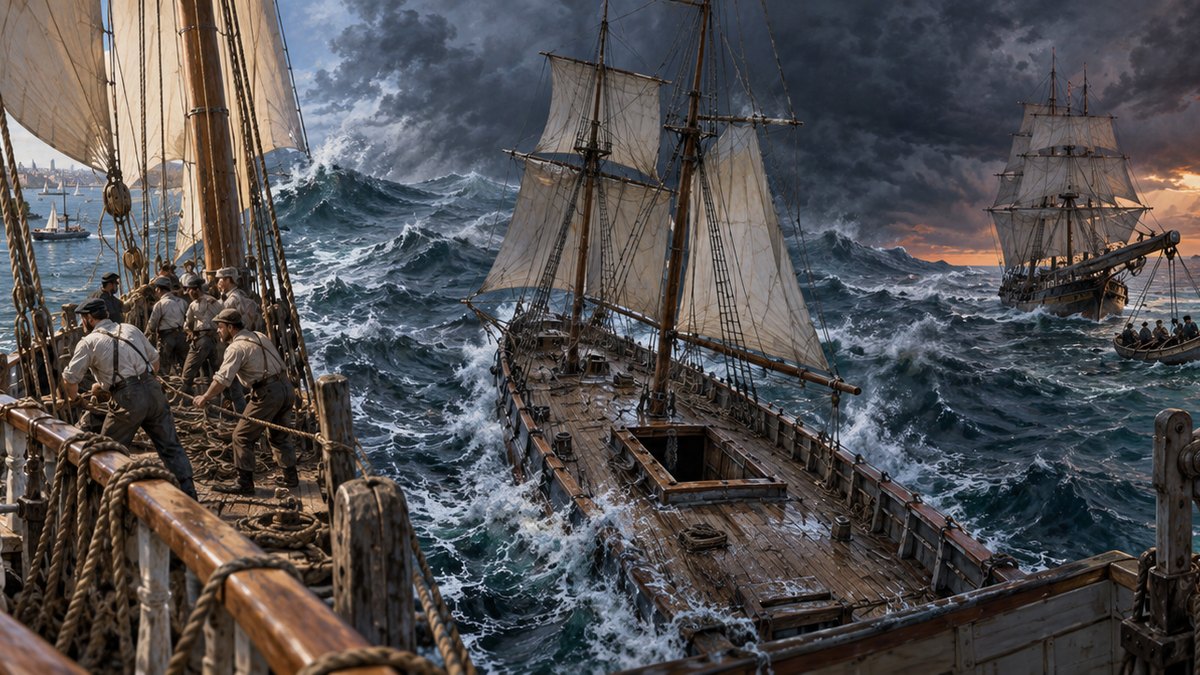
The Mary Celeste was not found with dinner still steaming and people vanished from their chairs. Those details came later. The real ship was strange enough: seaworthy, supplied, carrying cargo, missing its lifeboat, and completely empty.
What the video covers
The boarding party found a damaged but sail-able ship
Smithsonian records that the crew of Dei Gratia found Mary Celeste east of the Azores on December 5, 1872. The lifeboat was missing, one pump had been taken apart, and about three and a half feet of water was in the hold. Yet the salvagers were able to sail the abandoned vessel hundreds of miles to Gibraltar.
Ten people disappeared, including a small child
According to Smithsonian, Captain Benjamin Briggs sailed with his wife Sarah, their two-year-old daughter Sophia, and seven crewmen. No confirmed trace of any of them was found. The ship's last log information placed it near the Azores days before discovery. That gap matters because investigators could reconstruct the ship's condition, but not the final decision made aboard it.
The official inquiry found no proof of violence
The British vice admiralty salvage hearing in Gibraltar investigated whether the Dei Gratia crew or somebody aboard Mary Celeste had committed a crime. Smithsonian's review of the records notes that no evidence of foul play was established. The intact cargo and absence of convincing signs of struggle make pirates, mutiny, and murder much weaker explanations than generations of ghost stories suggest.
Arthur Conan Doyle helped make the legend stranger
Smithsonian notes that Arthur Conan Doyle published "J. Habakuk Jephson's Statement" in 1884, before Sherlock Holmes made him famous. It was fiction, not an investigation, and even altered the ship's name to Marie Celeste. Readers and later retellings blended invented details with the real case, helping create the familiar picture of an eerie ship abandoned in the middle of normal daily life.
The best modern reconstruction does not require an explosion
A Smithsonian-backed investigation led by Anne MacGregor found problems with the popular alcohol-fume explosion theory because the main hatch was secure and no strong fumes were reported. Her team instead highlighted rough weather, a faulty chronometer, a disassembled pump, and uncertainty about water in the hold. Briggs may have evacuated near land because he temporarily believed the ship was sinking.
Where this story comes from
The broad case is covered in the Wikipedia article "Mary Celeste." The most important primary sources are records from the 1872 and 1873 Gibraltar vice admiralty salvage proceedings, including testimony and notes made under Attorney General Frederick Solly-Flood. They preserve the condition of the vessel before later fiction transformed the case.
Why a shirt company tells this story
The Mary Celeste appeals to sailors, maritime-history readers, teachers, mystery fans, and anyone interested in how real events turn into legends. A design might use a brigantine silhouette, an Atlantic chart, an empty lifeboat davit, or a nineteenth-century compass rather than ghosts. It can be printed or embroidered on one shirt with no minimum. The real mystery is strong enough to wear without adding sea monsters or pretending one theory has been proven.
Watch it on YouTube: Found Sailing With Nobody Aboard. The Likeliest Truth. Subscribe to GoatNut for the next one.
Frequently asked questions
What happened to the crew of the Mary Celeste?
Nobody knows for certain. Evidence suggests Captain Briggs ordered everyone into the missing lifeboat, possibly because he feared the ship was taking on dangerous amounts of water. The occupants were never found.
Was alcohol leaking aboard the Mary Celeste?
Nine of 1,701 barrels were found empty, probably because their porous red-oak construction allowed leakage. Alcohol fumes have inspired evacuation theories, but modern investigators found no proof that an explosion occurred.
Was the Mary Celeste later destroyed for insurance money?
Yes. In 1885, under a different captain, Gilman C. Parker, the ship was deliberately wrecked on a reef near Haiti as part of an attempted insurance fraud involving falsely valued cargo.
Or start with the art: free AI design tool + all free tools →