Merch pricing advice is usually uselessly vague ("charge what your audience will pay"), so here are actual numbers. What per-shirt profit really looks like in print on demand, the two ways creators earn on merch here, and the pricing mistake almost every new creator makes (it's underpricing, not overpricing). Ready to order? creator merch, no minimum, pay in 4.
What the industry numbers actually say
Across print-on-demand sellers broadly, typical net profit lands around $3–8 per shirt, and established brands target 30–50% margins on their lines. Hoodies and premium pieces carry more absolute profit per sale than tees, which is why mature merch lines make most of their money on the warmer garments, not the $25 tee that gets the volume.
Route one: the affiliate model, zero handling, 10%
The simplest version: share your design's product link, and you earn 10% of every sale. No pricing decisions, no order handling, no customer service: the fan buys a tee at $16.99 or a hoodie from $32.99 and your cut arrives without you touching anything. For a channel that wants merch income without merch operations, this is the whole business. Details in make money selling merch as an affiliate.
Route two: the resale model. Buy bulk pricing, set your price
When drops get real, the margin gets real: orders of 25+ pieces in the same order flip to automatic bulk pricing in the cart. Buy a 25-piece drop at bulk pricing, sell at your own retail through your channels, and the spread is yours. Worked example with real numbers: the automatic bulk discount brings the $16.99 classic tee to about $15.80 each at 50 pieces, so if you retail at $30–35 (squarely normal for creator merch) you're netting roughly $14–19 per shirt before fees and shipping. The mechanics are covered in bulk custom t-shirts for resale.
The classic mistake: racing Amazon to the bottom
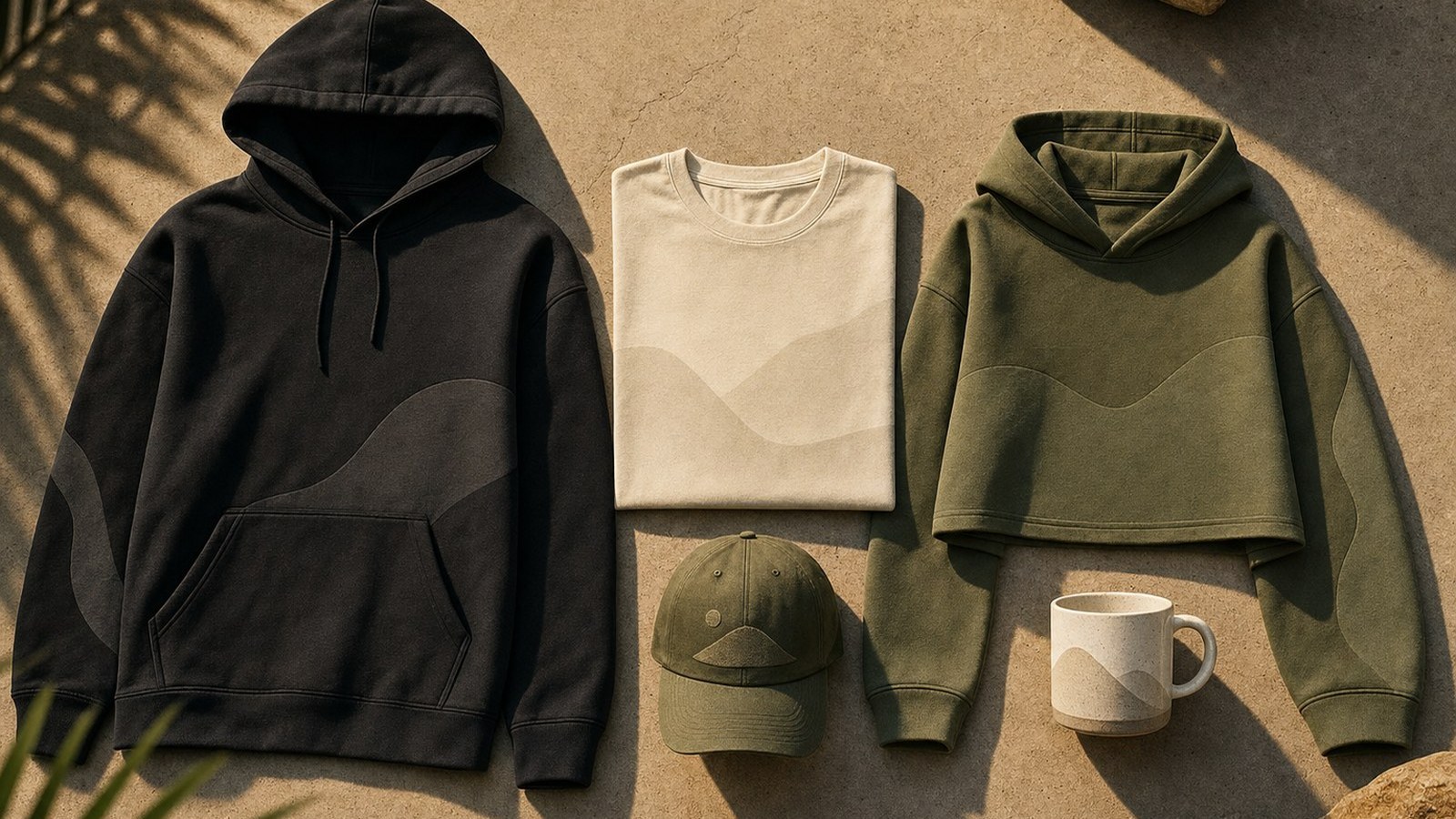
New creators price scared ($18 tees, $28 hoodies) trying to compete with commodity apparel. But fans aren't buying fabric; they're buying membership in your thing. Creator merch reliably sells at $25–35 for tees and $45–65 for hoodies across the industry, and underpricing actually reads as lower quality. Price like a brand: the crop hoodie holds at $67.99 because it looks and feels like streetwear, not because it's cheap. Our own pricing philosophy is public in how we price custom merch.
Three levers that lift what fans will pay
- Installments: Pay in 4 or monthly with PayPal, Affirm, Afterpay (including Cash App Afterpay) or Shop Pay Installments. Pay in 4 normally uses a soft check that does not affect your credit score. $0 down when you qualify. That turns a $50 crop hoodie into four small yeses. This single lever moves hoodie-tier conversion for young audiences.
- Drops over catalogs: a two-week window sells harder than an always-open store at the same price.
- Design quality: a design that looks like real streetwear supports real streetwear prices, and it's free to iterate in the AI design studio (3 free designs, then $1 for 5) until it does. Original designs only (your brand, not existing IP), which also means nothing about your line can get taken down later.
Put it together
Start affiliate while you're testing designs (zero risk, 10% of every sale). Switch hits to the resale model when a design proves it can carry a 25+ drop. Keep tee prices in the mid-$20s to low $30s and hoodies in the $45–65 lane. Pay in 4 or monthly with PayPal, Affirm, Afterpay (including Cash App Afterpay) or Shop Pay Installments. Pay in 4 normally uses a soft check that does not affect your credit score. $0 down when you qualify. New to the whole pipeline? The end-to-end walkthrough is how to start your YouTube merch line.
See the merch in real life
Real garments, printed and embroidered to order.
Good to know
Frequently asked questions
How much profit should I expect per shirt?
Print-on-demand sellers typically net $3–8 per shirt; strong creator brands target 30–50% margins. On the resale model (25+ drops at automatic per-product bulk pricing, retailing at normal creator prices of $30–35) roughly $7–12 per shirt before fees is realistic. Have an idea already? Try it in the builder.
What should creators charge for merch?
Industry-normal creator pricing runs $25–35 for tees and $45–65 for hoodies. Underpricing is the common mistake: fans are buying membership in your brand, and bargain pricing reads as low quality. Ready to see yours? Build it here.
What's the easiest way to earn on merch with no operations?
The affiliate route: share your design's link and earn 10% of every sale with zero handling, pricing, or customer service. Switch proven designs to the bulk-resale model when drops of 25+ make sense. Play with the builder here and see your idea on a shirt.
Does pay-in-4 actually change what fans spend?
Yes. Pay in 4 or monthly with PayPal, Affirm, Afterpay (including Cash App Afterpay) or Shop Pay Installments. Pay in 4 normally uses a soft check that does not affect your credit score. $0 down when you qualify. Make your custom shirt here.
How does bulk pricing work?
Orders of 25+ pieces in the same order flip to automatic bulk pricing in the cart, no quote emails. That's the mechanism that makes the buy-and-resell margin model work for creator drops. Want to see it first? Try the shirt builder here.
Why do merch prices ending in .99 sell better?
Charm pricing works because buyers anchor on the leftmost digit, so $24.99 registers closer to twenty-something while $25.00 reads as twenty-five. The effect is small per transaction but consistent across a whole store, which is why nearly every major retailer uses it. For creator merch the practical rule is simple: price just under the round-number thresholds your audience is sensitive to, like $24.99, $39.99, and $49.99. Open the builder and try your idea on a shirt.
Can pricing merch too low actually hurt sales?
Yes, and it is one of the least intuitive findings in merch pricing. Price is a quality signal, so a $12 hoodie makes buyers suspect thin fabric and a print that dies in the wash, while $45-55 on a heavyweight hoodie matches expectations for premium apparel. Underpricing also starves you of margin for promotion and makes later price corrections feel like increases. Price to the value of the garment and design, not to your own nervousness. When you are ready, start your shirt here.
How does anchor pricing work in a merch store?
Anchoring means including a higher-priced item so your core products look reasonable by comparison. If your store shows a $49 hoodie next to a $16.99 tee, the tee reads as the accessible choice, whereas the same tee alone might trigger price hesitation. This is why a small line spanning a value item, a core item, and a premium item usually converts better than a store of identical-priced products; the range itself does persuasive work.
What costs do creators forget when pricing merch?
The blank and the print are only the visible costs; platform fees, payment processing, shipping subsidies, packaging, returns, ad spend, and taxes all quietly eat into what looks like margin. A shirt with a $15 landed cost sold at $25 is not $10 profit once 3 percent processing and a discount code touch it. Build your price from true all-in cost, then apply your target margin, rather than guessing a retail number and hoping the math survives. See your idea on a shirt here. It is free to try.
Should hoodies always be priced higher than tees?
Yes, both because they cost more to produce and because buyers expect it; hoodies are perceived as outerwear-tier products, and pricing them near your tees actually undermines the whole lineup. A common healthy ladder is a tee in the mid-$20s and a hoodie in the $45-55 band, which preserves margin on the item fans already expect to spend more on. The hoodie premium also does double duty as the price anchor that makes tees feel easy to buy. You can try it here: design your own shirt.
Customize authentic blanks with your own original logo, slogan, or artwork. We do not print protected logos, copyrighted artwork, celebrity likenesses, game assets, team marks, or designs you do not have rights to use.
Or start with the art: design it in our custom builder → · free AI t-shirt design generator
Keep reading
More from the journal