 Your design here
Design it right now
Classic Tee — with YOUR design on it
Upload art, type text, or let the AI design it — live preview, no minimums, pay over time, ships in 5–9 days.
Split eligible US orders into 4 interest-free payments with Shop Pay
🎨 Put my design on this →Gildan 5000 · 100% cotton · 5.0–5.3 oz/yd² (170-180 g/m²) · blank sourced from Honduras · printed in the USA network · ships 5–9 days
Dyatlov Pass became famous because the evidence looked as if it should fit together, but did not. Nine experienced hikers left a tent in deadly cold, some without proper footwear, and nobody survived to explain the decision. Modern snow science has made one explanation much more plausible.
What the video covers
The expedition originally had ten hikers
Records from the 1959 expedition show that Yuri Yudin began the journey with the group but turned back because of illness. That decision made him the only member of the hiking party to survive. According to material preserved from the Soviet investigation, the remaining nine continued toward Otorten mountain before poor visibility contributed to their camp on the exposed slope of Kholat Syakhl.
The tent was damaged from the inside
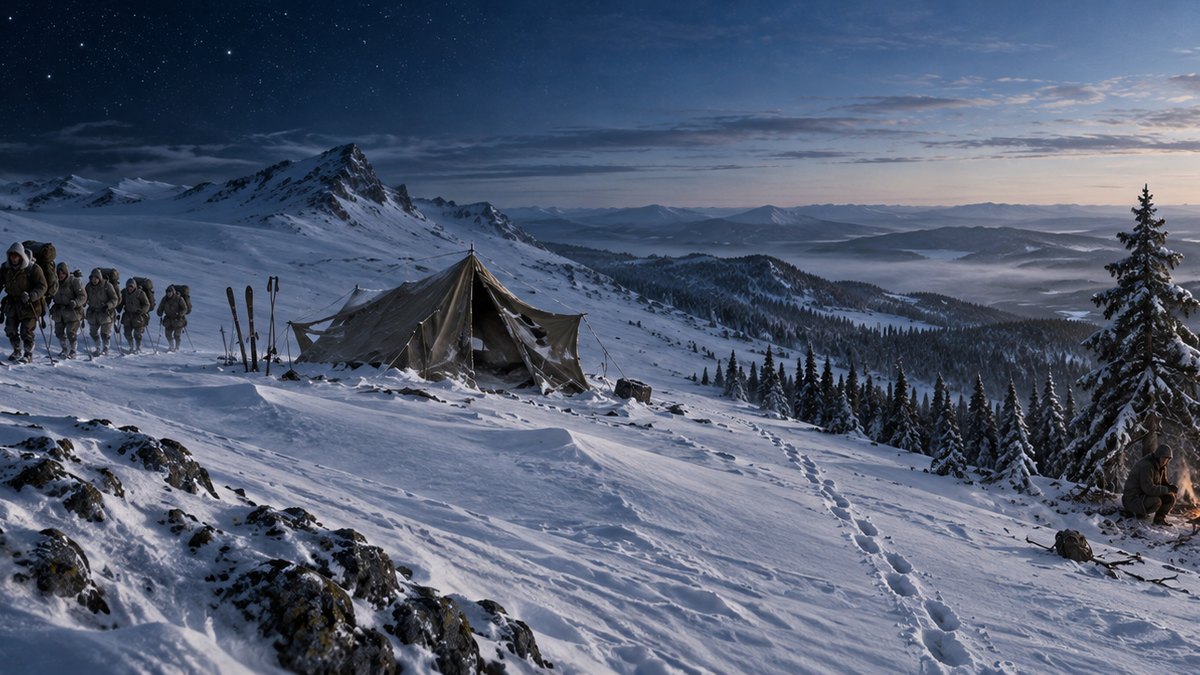
The original Soviet investigation recorded cuts in the tent fabric that forensic examination concluded had been made from inside. Searchers also found footwear, clothing, food, and equipment left behind. That evidence is important because it suggests the group believed leaving immediately was safer than taking time to dress and exit normally, even though the outside temperature created its own life-threatening danger.
The footprints led away in a surprisingly orderly way
Search records cited by modern Dyatlov researchers describe tracks descending toward the forest rather than signs of a chaotic sprint in every direction. Some hikers wore socks or only partial footwear. According to the 1959 case materials, the first two bodies were eventually found beneath a cedar near the remains of a small fire, while additional victims lay between the tree and camp.
A slab avalanche can happen on a modest slope
In 2021, snow scientists Johan Gaume and Alexander Puzrin published a physical model showing how cutting into the slope for the tent, unusual terrain, and wind-deposited snow could have produced a delayed slab release. Their study also modeled how a compact snow slab could cause serious chest injuries without leaving the enormous avalanche debris field investigators expected from a large flowing avalanche.
The model explains much, but it does not prove every moment
Gaume and Puzrin explicitly described their work as a plausible physical mechanism rather than a complete reconstruction of the night. Russian prosecutors also concluded in 2020 that an avalanche was the likely cause of the emergency. Hypothermia and traumatic injuries account for the deaths medically, but exactly how the group moved, became separated, and made each decision remains partly unknowable.
Where this story comes from
The overview appears in the Wikipedia article "Dyatlov Pass incident." The central primary source is the original 1959 Soviet criminal investigation file, including search reports, tent examination, photographs, witness statements, and autopsy records. Those documents matter because every later explanation has to account for the physical evidence investigators actually recorded.
Why a shirt company tells this story
Dyatlov Pass interests hikers, mountaineers, cold-weather experts, engineers, mystery readers, and people who like seeing old puzzles tested with new science. A design might use a mountain contour, a tent outline, expedition coordinates, or a snow-slab diagram without turning nine real deaths into a monster story. It can be printed or embroidered on one shirt with no minimum. Sometimes the most interesting design is the one that respects uncertainty instead of exaggerating it.
Watch it on YouTube: Nine Hikers Cut Their Way Out Of Their Tent. Now We Know Why. Subscribe to GoatNut for the next one.
Frequently asked questions
What is the most likely explanation for Dyatlov Pass?
An avalanche or snow-slab emergency followed by exposure is now one of the strongest explanations. Modern modeling shows such a slab was physically possible, although the exact sequence of events cannot be proven.
Why did the Dyatlov hikers cut their tent open?
The cuts suggest they believed there was an immediate threat near or above the normal entrance. A snow-slab danger could explain why experienced hikers chose to leave quickly despite extreme cold.
Did scientists solve the Dyatlov Pass mystery in 2021?
Not completely. The 2021 study demonstrated a credible mechanism for a delayed slab avalanche and unusual injuries. It strengthened the avalanche explanation but did not reconstruct every action taken by the hikers.
Or start with the art: free AI design tool + all free tools →