 Your design here
Design it right now
Classic Tee — with YOUR design on it
Upload art, type text, or let the AI design it — live preview, no minimums, pay over time, ships in 5–9 days.
Split eligible US orders into 4 interest-free payments with Shop Pay
🎨 Put my design on this →Gildan 5000 · 100% cotton · 5.0–5.3 oz/yd² (170-180 g/m²) · blank sourced from Honduras · printed in the USA network · ships 5–9 days
The most famous clue in the Lost Colony mystery looks ominous only if you remove its context. CROATOAN was not a mysterious spell. It was the name of a nearby island and community, and John White believed the carving was telling him where the colonists had gone.
What the video covers
John White had left his own family behind
The National Park Service records that White sailed back to England in 1587 to obtain supplies, leaving more than one hundred colonists at Roanoke. Among them were his daughter Eleanor Dare and granddaughter Virginia Dare, born shortly after the settlement began. War with Spain and the Spanish Armada disrupted English shipping, helping turn what was supposed to be a supply trip into an absence of nearly three years.
He returned on a painfully specific date
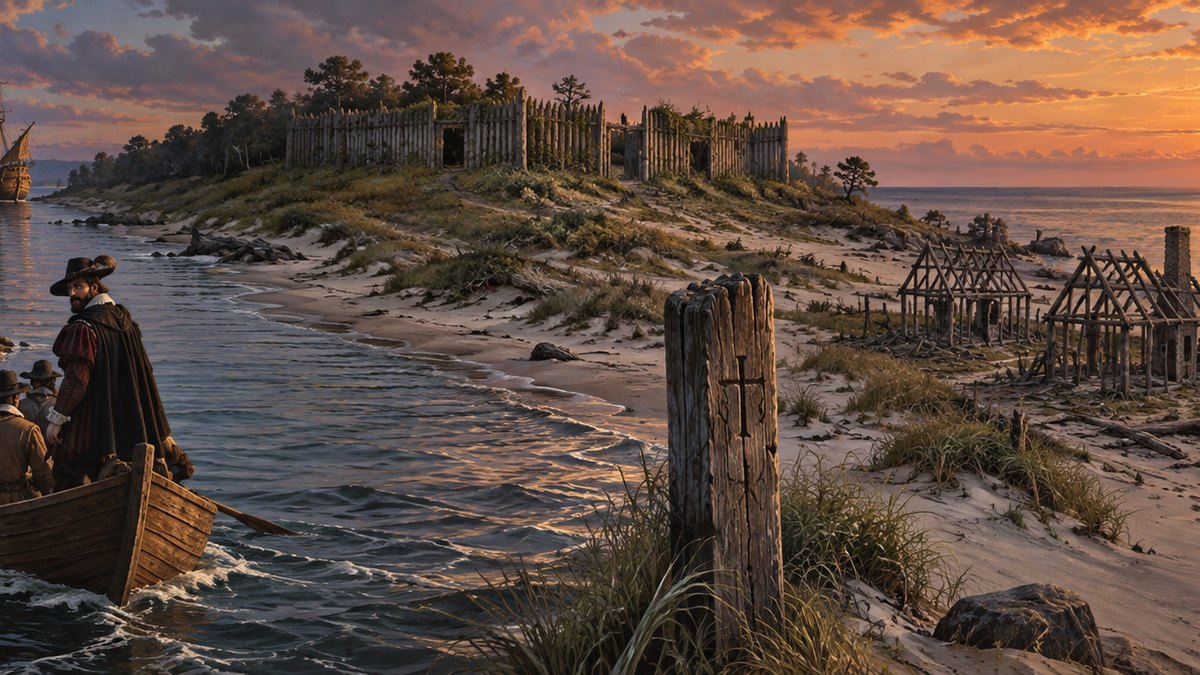
White finally reached Roanoke Island on August 18, 1590. The National Park Service notes that the date was Virginia Dare's third birthday. He found no colonists waiting for him. The houses had been removed rather than simply abandoned in place, and a defensive palisade had been constructed. There were no obvious signs that the settlement had been destroyed in a sudden attack.
The colonists had agreed to leave a destination
Before departing for England, White had arranged for the settlers to carve the name of their destination if they moved. His own account says that if they were forced away in distress, they were also to add a cross above the message. When he returned, he found “CRO” on a tree and “CROATOAN” carved into a post, with no distress cross.
Croatoan was a real place with friendly connections
The National Park Service identifies Croatoan as the island now known as Hatteras Island. It was also associated with the Croatoan people and Manteo, an Indigenous man who had traveled to England and maintained close relations with the colonists. White therefore did not interpret the word as sinister. He was encouraged by it and believed the settlers had probably relocated to Croatoan.
A storm prevented the obvious next step
White tried to reach Croatoan, but rough weather and problems with the expedition forced the ship away. According to the National Park Service, he ultimately returned to England without reaching the island and never got another opportunity to search the colony himself. Later archaeological discoveries on Hatteras Island have fueled theories of integration with local communities, but no single find has conclusively identified the fate of every Roanoke colonist.
Where this story comes from
The broad mystery appears in the Wikipedia article “Roanoke Colony.” The essential primary source is John White's own account of his 1590 return voyage, later published in Richard Hakluyt's collections of English exploration. White personally described finding CRO and CROATOAN, remembered the agreed signal involving a cross for distress, and explained why he believed the carving pointed toward the nearby island.
Why a shirt company tells this story
Roanoke belongs to history teachers, North Carolina travelers, archaeologists, genealogy fans, mystery readers, and people fascinated by how one word can outlive an entire settlement. A design might use CROATOAN as part of a period map, a shoreline outline, a carved-post texture, or the route between Roanoke and Hatteras. It can be printed or embroidered on one shirt with no minimum. The best part of the mystery is that the famous clue becomes less supernatural and more human once you know what White thought it meant.
Watch it on YouTube: The Lost Colony Left One Word Behind. It Was An Address. Subscribe to GoatNut for the next one.
Frequently asked questions
What does Croatoan mean in the Lost Colony mystery?
Croatoan was the name of a nearby island and Indigenous community, associated with modern Hatteras Island. John White understood the carving as a message that the colonists had relocated there.
Why did John White not search Croatoan Island?
White wanted to sail there after finding the carving, but severe weather and problems with the ship prevented the search. The expedition was forced away, and White never returned to investigate personally.
Was there a distress signal at Roanoke?
White had asked the colonists to add a cross if they were forced to relocate under distress. His account says no such cross appeared with the Croatoan message, which initially reassured him.
Or start with the art: free AI design tool + all free tools →