 Your design here
Design it right now
Classic Tee — with YOUR design on it
Upload art, type text, or let the AI design it — live preview, no minimums, pay over time, ships in 5–9 days.
Split eligible US orders into 4 interest-free payments with Shop Pay
🎨 Put my design on this →Gildan 5000 · 100% cotton · 5.0–5.3 oz/yd² (170-180 g/m²) · blank sourced from Honduras · printed in the USA network · ships 5–9 days
Wilbur and Orville Wright did not stumble into flight with one lucky machine. They spent years breaking the problem into smaller ones, testing what experts thought they already knew, and rebuilding when the numbers failed. The famous 12 seconds came after a lot of unglamorous work.
What the video covers
The bicycle shop gave them useful engineering habits
The Smithsonian notes that the brothers operated a bicycle sales and repair business in Dayton, Ohio, while pursuing flight experiments. They had no university engineering degrees, but bicycle work taught them about lightweight structures, chains, bearings, balance, and precise mechanical adjustment. Just as important, running their own shop gave them tools, income, and the freedom to build experimental parts themselves.
They built a wind tunnel because the old data failed
The Smithsonian records that the Wrights’ 1900 and 1901 gliders produced less lift than their calculations predicted. Instead of blaming the machines, they questioned published aerodynamic tables. In late 1901 they built a small wind tunnel and tested hundreds of wing shapes. Those experiments produced more reliable lift and drag data and helped shape the successful 1902 glider that came before powered flight.
Charlie Taylor built the engine when manufacturers could not help
The National Park Service credits mechanic Charlie Taylor with helping the brothers build the four-cylinder engine for the 1903 Flyer after available commercial engines were too heavy. The finished motor produced roughly 12 horsepower while remaining light enough to fly. The Wrights also discovered that efficient propellers were not simply marine screws in air, so they developed their own propeller theory and carved the blades themselves.
Wilbur won the toss, then damaged the Flyer
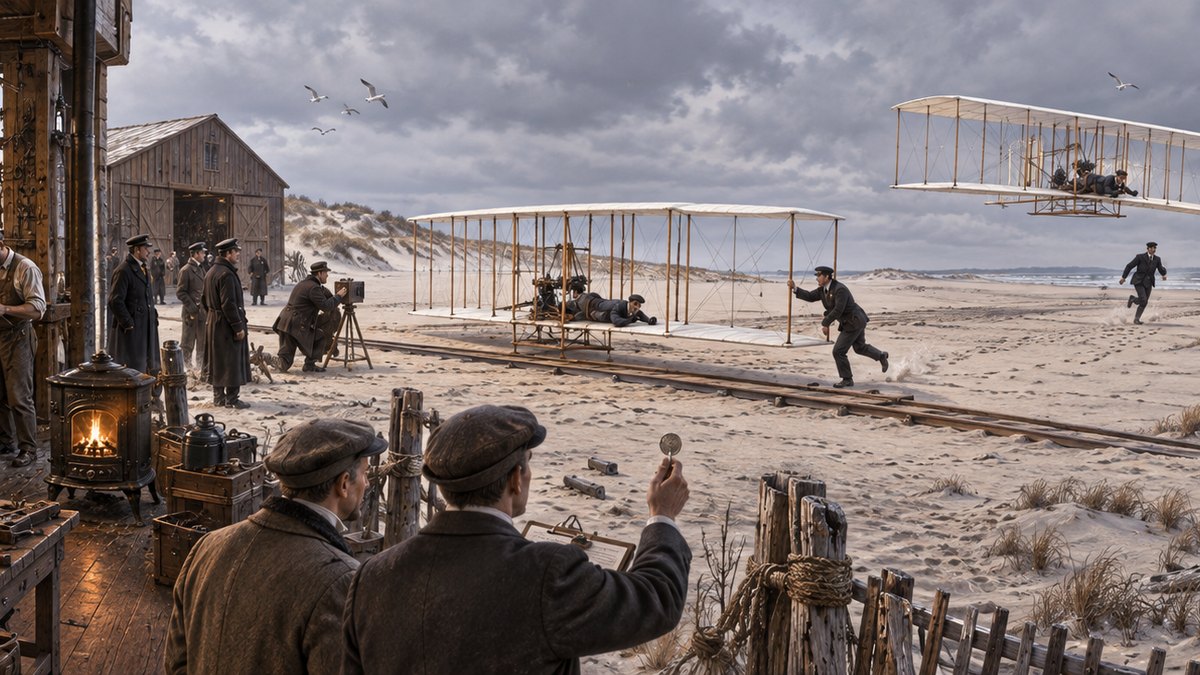
On December 14, 1903, Wilbur won a coin toss for the first attempt. According to the National Park Service, the Flyer climbed too steeply after leaving its launch rail and stalled, dropping onto the sand and suffering minor damage. Repairs delayed the next try. Three days later the brothers returned in strong winds, and this time Orville took the controls.
Four flights changed aviation in one morning
The Smithsonian records Orville’s first December 17 flight at 120 feet in 12 seconds. Three more followed. Wilbur made the longest, covering 852 feet in 59 seconds. Afterward, a gust caught the unattended Flyer and rolled it across the sand, damaging it beyond immediate repair. The airplane that proved controlled powered flight never flew again, but the brothers already had the evidence they needed.
Where this story comes from
The broad history appears in the Wikipedia article “Wright brothers.” One essential primary source is the telegram Orville Wright sent to his father from Kitty Hawk on December 17, 1903, reporting four successful flights against a strong wind. The brothers’ notebooks, photographs, letters, and wind-tunnel records preserve the longer experimental path behind that short message.
Why a shirt company tells this story
The Wright brothers belong to pilots, cyclists, mechanics, engineers, teachers, aviation students, and anyone who likes stories where persistence matters more than credentials. A design might use the Flyer’s wing plan, a bicycle chain beside a propeller, the 120-foot first-flight distance, or a wind-tunnel sketch. It can be printed or embroidered on one shirt with no minimum. Sometimes a shirt can carry a reminder that a world-changing idea began in a workshop with people willing to test the numbers again.
Watch it on YouTube: Two Bike Mechanics Flew For 12 Seconds And Opened The Sky. Subscribe to GoatNut for the next one.
Frequently asked questions
How long was the Wright brothers' first flight?
Orville Wright's first successful powered flight on December 17, 1903 lasted about 12 seconds and covered 120 feet. The brothers completed three additional flights that morning at Kitty Hawk.
Who built the engine for the Wright Flyer?
The Wright brothers designed the engine with help from their Dayton bicycle-shop mechanic, Charlie Taylor. Taylor machined and assembled the lightweight four-cylinder engine used on the 1903 Wright Flyer.
Why did the Wright brothers build a wind tunnel?
Their early gliders produced less lift than expected, making them doubt published aerodynamic data. Their wind tunnel let them test wing shapes directly and develop more accurate measurements for later aircraft.
Or start with the art: free AI design tool + all free tools →