 Your design here
Design it right now
Classic Tee — with YOUR design on it
Upload art, type text, or let the AI design it — live preview, no minimums, pay over time, ships in 5–9 days.
Split eligible US orders into 4 interest-free payments with Shop Pay
🎨 Put my design on this →Gildan 5000 · 100% cotton · 5.0–5.3 oz/yd² (170-180 g/m²) · blank sourced from Honduras · printed in the USA network · ships 5–9 days
Modern dialysis began with machines that looked improvised because they were. During World War II, Dutch physician Willem Kolff used whatever materials he could find to build a device that moved waste out of blood. The early failures were devastating, but the basic idea eventually changed kidney failure from an almost certain death sentence into a treatable condition.
What the video covers
Kolff built with materials available under occupation
Medical histories in the National Library of Medicine describe Kolff’s rotating-drum kidney as a product of wartime scarcity in the Netherlands. He used cellophane tubing similar to sausage casing as the dialysis membrane and improvised pumps, drums, containers, and mechanical parts from ordinary equipment. The machine worked because small waste molecules could cross the membrane while blood cells and larger components stayed inside.
The first successful patient came after repeated losses
Kolff treated 16 early patients with his rotating-drum system before achieving a clear survival. A 67-year-old woman, Sophia Schafstadt, arrived in 1945 with severe kidney failure and regained consciousness after a long dialysis treatment. Historical reviews report that her kidneys recovered and she lived about seven more years. That success proved temporary artificial blood purification could keep someone alive long enough for kidney function to return.
Scribner made repeated dialysis possible
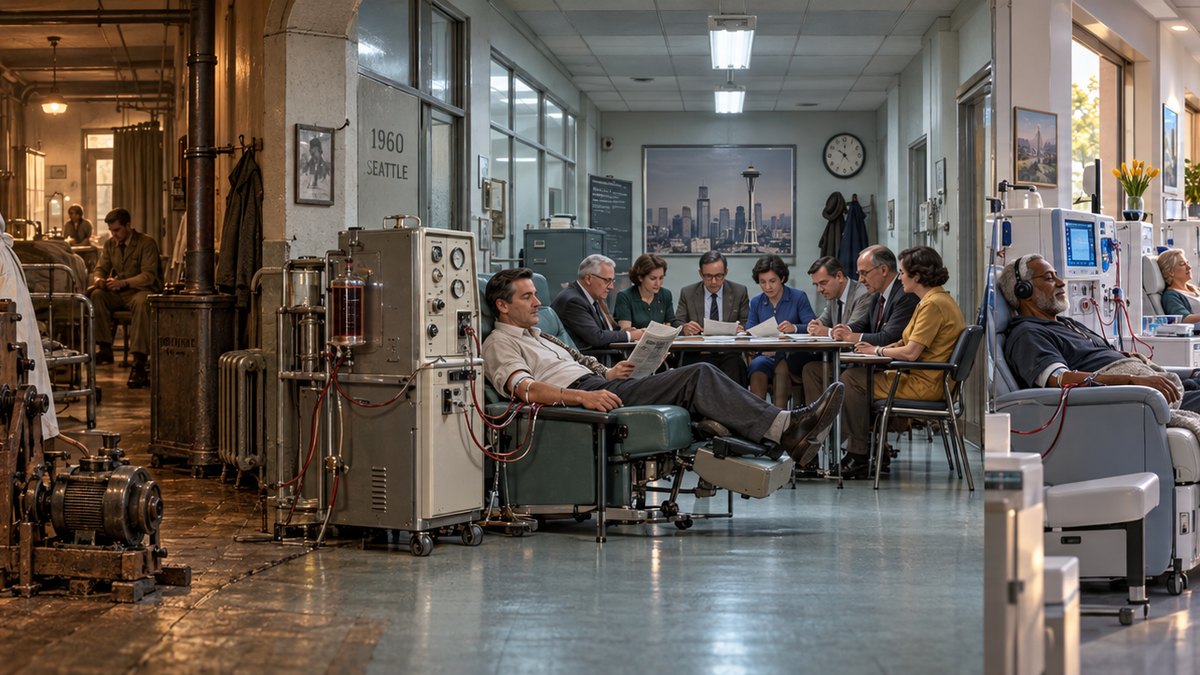
Acute dialysis could help for a short crisis, but repeated treatment damaged blood vessels because new access had to be created again and again. In 1960, University of Washington physician Belding Scribner worked with Wayne Quinton and David Dillard on an external Teflon shunt connecting an artery and vein. Medical histories credit that device with making long-term maintenance hemodialysis practical for chronic kidney failure.
Scarcity created one of medicine’s famous ethics debates
Northwest Kidney Centers records that the first community outpatient dialysis center opened in Seattle in 1962 with very limited capacity. Medically suitable patients outnumbered available treatment slots, so a lay admissions committee helped choose who would receive dialysis. The public later called it the “Life and Death Committee.” Its decisions became an early case study in how medicine should allocate scarce lifesaving technology.
The future is smaller, but it is not here yet
Standard hemodialysis still commonly requires hours of treatment several times a week, although schedules vary by patient and method. Researchers are working on portable, wearable, and implantable alternatives. As of 2026, UCSF’s Kidney Project says its implantable bioartificial kidney has not yet entered human clinical trials. Small-scale animal prototypes have worked, but significant preclinical engineering and funding remain before human testing can begin.
Where this story comes from
The broad history appears in the Wikipedia article “Kidney dialysis.” A key primary source is Willem Kolff and Hendrik Berk’s early paper describing their artificial kidney with a large dialysis surface. Scribner’s later publications on chronic hemodialysis document the next major step, when reliable vascular access turned a temporary rescue technology into a treatment that could be repeated for years.
Why a shirt company tells this story
Dialysis history matters to nurses, doctors, engineers, biomedical students, patients, caregivers, and families who know how much life can depend on a machine and the people running it. A design might use a rotating-drum diagram, membrane pattern, simple kidney outline, or old medical schematic. It can be printed or embroidered on one shirt with no minimum. Wearing the subject can honor both the science and the long chain of people who kept improving it.
Watch it on YouTube: It Was Built From Sausage Casings. It Still Saves Lives Every Day. Subscribe to GoatNut for the next one.
Frequently asked questions
Who invented the first practical dialysis machine?
Dutch physician Willem Kolff developed the rotating-drum artificial kidney during World War II. Earlier researchers had experimented with dialysis, but Kolff's work produced the first machine to successfully save a patient with severe kidney failure.
Why was the Scribner shunt important for dialysis?
The 1960 Scribner shunt provided reusable access to a patient's bloodstream between treatments. That breakthrough made repeated long-term hemodialysis practical for people with chronic kidney failure instead of limiting dialysis mainly to short acute illnesses.
Is an implantable artificial kidney available yet?
No. As of 2026, UCSF's Kidney Project says its implantable bioartificial kidney remains in preclinical development and has not begun human trials. Researchers continue testing and refining components before first-in-human studies can start.
Or start with the art: free AI design tool + all free tools →