 Your design here
Design it right now
Classic Tee — with YOUR design on it
Upload art, type text, or let the AI design it — live preview, no minimums, pay over time, ships in 5–9 days.
Split eligible US orders into 4 interest-free payments with Shop Pay
🎨 Put my design on this →Gildan 5000 · 100% cotton · 5.0–5.3 oz/yd² (170-180 g/m²) · blank sourced from Honduras · printed in the USA network · ships 5–9 days
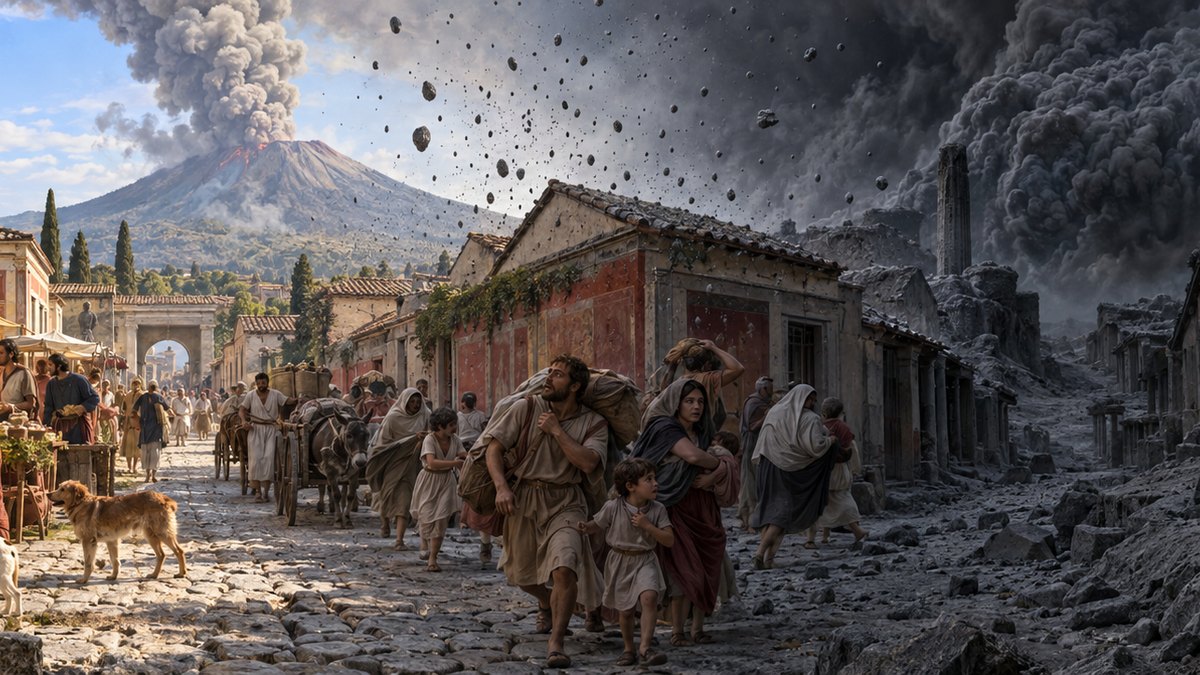
Pompeii is often imagined as a city frozen without warning in a single explosive moment. The real disaster unfolded for hours. That longer timeline explains why many people escaped, why others stayed, and why archaeologists can reconstruct the final day in unusual detail.
The five things
Romans did not understand Vesuvius as we do
The Smithsonian's Global Volcanism Program records major ancient eruptions of Vesuvius separated by long quiet periods. Roman communities farmed its fertile slopes and built settlements around the mountain. They experienced earthquakes, including a damaging one in AD 62 or 63, but lacked modern volcanic science that could connect shaking, buried prehistoric eruptions, magma, and future explosive danger into one recognizable warning system.
The first phase gave people hours to react
Pliny the Younger described an enormous cloud rising over Vesuvius while pumice and ash fell across the region. Modern work by the Pompeii Archaeological Park reconstructs many hours of pumice fall before the deadliest later phase. Roofs became overloaded and streets filled with debris, but the extended timeline means large numbers of residents had an opportunity to flee before conditions became impossible.
The deadliest danger arrived as hot surges
Research summarized by the Pompeii Archaeological Park shows that later pyroclastic currents swept through the area as hot mixtures of gas, ash, and volcanic particles. These currents can move rapidly and overwhelm people who cannot outrun them. At nearby Herculaneum, volcanic conditions differed because of location, but both sites demonstrate why an eruption can change from falling debris to a far more lethal ground-hugging hazard.
The famous figures are casts of empty spaces
The Pompeii Archaeological Park credits nineteenth-century excavator Giuseppe Fiorelli with developing the plaster-casting method in 1863. Decomposed bodies had left cavities inside hardened volcanic deposits. Archaeologists poured plaster into those spaces before removing surrounding ash. The resulting forms preserve body positions and sometimes impressions of clothing, while surviving bones can remain enclosed within the casts themselves.
Archaeologists deliberately do not uncover everything
The Pompeii Archaeological Park says roughly one-third of the ancient city remains unexcavated. Modern archaeology treats untouched ground as a resource, not unfinished work. Excavation immediately exposes walls, paintings, floors, wood traces, and other fragile material to weather and decay. Leaving areas buried preserves evidence for future researchers who may have better imaging, conservation methods, laboratory techniques, and questions that nobody has considered yet.
Where this story comes from
The broad history appears in the Wikipedia article "Pompeii." The essential primary source is Pliny the Younger's two letters to the historian Tacitus describing the AD 79 eruption. Pliny watched events from across the Bay of Naples and recorded the experiences of his uncle, Pliny the Elder, who sailed toward the disaster and died near Stabiae.
Why a shirt company tells this story
Pompeii interests archaeologists, travelers, teachers, classicists, volcano watchers, artists, and anyone fascinated by ordinary lives preserved through an extraordinary disaster. A design might use a Roman street plan, Vesuvius outline, mosaic pattern, amphora, or archaeological drawing without treating the victims as decoration. It can be printed or embroidered on one shirt with no minimum. History becomes more meaningful when what you wear points toward the people, science, and evidence behind the famous image.
Watch it on YouTube: 5 Things Nobody Tells You About Pompeii. Subscribe to GoatNut for the next one.
Frequently asked questions
Was Pompeii destroyed instantly?
No. The eruption developed over many hours, beginning with heavy pumice and ash fall. Many residents apparently escaped during that period. Later fast-moving hot volcanic currents were especially deadly to people who remained.
Are the Pompeii plaster casts actual bodies?
The visible forms are plaster casts created by filling cavities left after bodies decomposed inside hardened volcanic deposits. Human bones can still remain within some casts, but the outer shape itself is plaster.
Why is part of Pompeii still buried?
Excavation exposes fragile archaeology to weather and deterioration. Leaving about a third of the city underground protects evidence for future researchers and allows conservation resources to focus on structures that have already been uncovered.
Or start with the art: free AI design tool + all free tools →