 Your design here
Design it right now
Classic Tee — with YOUR design on it
Upload art, type text, or let the AI design it — live preview, no minimums, pay over time, ships in 5–9 days.
Split eligible US orders into 4 interest-free payments with Shop Pay
🎨 Put my design on this →Gildan 5000 · 100% cotton · 5.0–5.3 oz/yd² (170-180 g/m²) · blank sourced from Honduras · printed in the USA network · ships 5–9 days
The Hindenburg disaster is usually remembered as one photograph of a giant airship on fire. That frozen image hides how advanced, luxurious, carefully managed, and strangely vulnerable the aircraft had seemed only seconds earlier.
The five things
Hydrogen was not the designers’ first preference
Airship historian Dan Grossman’s Hindenburg research shows that the Zeppelin Company shifted its design toward helium after earlier hydrogen-airship disasters. Helium offered less lift but was not flammable. The United States controlled the world’s practical helium supply and restricted exports. Hindenburg therefore operated with hydrogen, which gave excellent lift but created a much more serious fire risk.
The smoking room had its own safety system
According to Airships.net, the smoking room was kept at slightly higher pressure and separated by a double-door airlock. Passengers had to surrender matches and personal lighters before boarding. Inside, a steward supervised the room and one electric lighter was provided. The arrangement sounds absurd on a hydrogen airship, but it shows how designers tried to isolate a known ignition source.
It was closer to an ocean liner than a modern plane
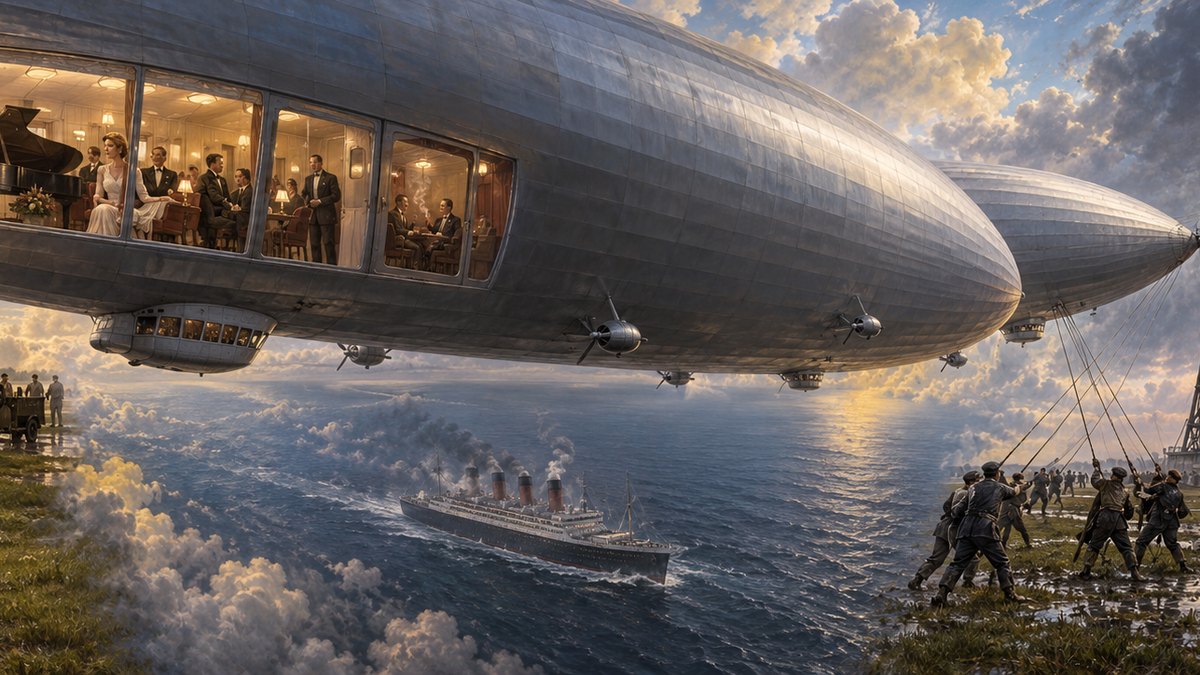
The Hindenburg had dining areas, cabins, a lounge, writing space, and even a specially built lightweight piano during part of its service. Airships.net notes that large windows gave passengers broad views while the ship cruised relatively low. The attraction was not only speed. It offered a quiet, spacious style of travel that disappeared when long-range airplanes became practical.
The survival rate surprises people
Smithsonian’s Air & Space reporting notes that 62 of the 97 passengers and crew aboard survived the Lakehurst disaster. Many escaped through windows or openings as the burning ship settled toward the ground. One member of the ground crew also died. The famous film looks instantly unsurvivable, but the low altitude and the way the hull descended gave many people a narrow path out.
The final collapse happened incredibly fast
Smithsonian records that the visible destruction took about 34 seconds. Radio reporter Herbert Morrison was already covering the landing and his emotional eyewitness recording later became inseparable from the event. The speed mattered culturally as much as mechanically. A vehicle marketed as the future of transatlantic travel was transformed, in less than a minute, into the image that helped end the passenger-airship age.
Where this story comes from
The basic event is covered in the Wikipedia article “Hindenburg disaster.” One unforgettable primary source is Herbert Morrison’s live radio report from Lakehurst on May 6, 1937. His recording captures what an eyewitness saw and heard as the airship caught fire while approaching the mooring field.
Why a shirt company tells this story
Airships still fascinate aviation fans, engineers, history teachers, retro-futurism collectors, and people drawn to technologies that almost became normal. The Hindenburg can inspire a clean silhouette, route map, cabin detail, or old-airship badge without celebrating the disaster itself. That design can be printed or embroidered on one shirt with no minimum. Sometimes what people want to wear is not the tragedy, but the strange lost future surrounding it.
Watch it on YouTube: 5 Things Nobody Tells You About The Hindenburg. Subscribe to GoatNut for the next one.
Frequently asked questions
Why did the Hindenburg use hydrogen instead of helium?
The airship was designed to be compatible with helium, but the United States controlled the main helium supply and restricted exports. The Zeppelin Company therefore used hydrogen, which provided strong lift but was flammable.
Did the Hindenburg really have a smoking room?
Yes. It was separated from other passenger areas by an airlock, kept under slightly higher pressure, supervised by a steward, and equipped with a single electric lighter.
How many people survived the Hindenburg disaster?
Sixty-two of the 97 passengers and crew aboard survived. Thirty-five people on the airship died, and one member of the ground crew was also killed.
Or start with the art: free AI design tool + all free tools →