 Your design here
Design it right now
Classic Tee — with YOUR design on it
Upload art, type text, or let the AI design it — live preview, no minimums, pay over time, ships in 5–9 days.
Split eligible US orders into 4 interest-free payments with Shop Pay
🎨 Put my design on this →Gildan 5000 · 100% cotton · 5.0–5.3 oz/yd² (170-180 g/m²) · blank sourced from Honduras · printed in the USA network · ships 5–9 days
The Mona Lisa was already respected before 1911, but respect is not the same as global celebrity. A theft, a police investigation, newspapers, reproductions, and later attacks helped turn a small Renaissance portrait into the most watched painting in the world.
The five things
The theft turned art history into breaking news
The Louvre says Vincenzo Peruggia, an Italian worker who had done work at the museum, stole the painting in August 1911. The empty space on the wall became an attraction of its own as newspapers followed the case. The painting was recovered in Florence in 1913. Its disappearance helped move the Mona Lisa from famous artwork to international popular icon.
Picasso was pulled into a different theft scandal
Pablo Picasso was questioned during the Mona Lisa investigation because stolen ancient Iberian objects had previously reached his circle through Géry Pieret. National Geographic notes that poet Guillaume Apollinaire was also arrested and questioned. Neither man stole the Mona Lisa. Their involvement shows how the police investigation widened into Paris’s avant-garde art world when authorities were desperate for leads.
The eyebrow question is less simple than it looks
The Louvre describes Leonardo’s technique as built from thin, subtle layers that create soft transitions. The sitter’s eyebrows are barely visible today, but scholars have debated whether they were originally painted and later faded, cleaned away, or were intentionally understated. High-resolution technical study has found details invisible in ordinary viewing, so “she had no eyebrows” is better treated as a visual mystery than a settled fact.
It is smaller than its fame
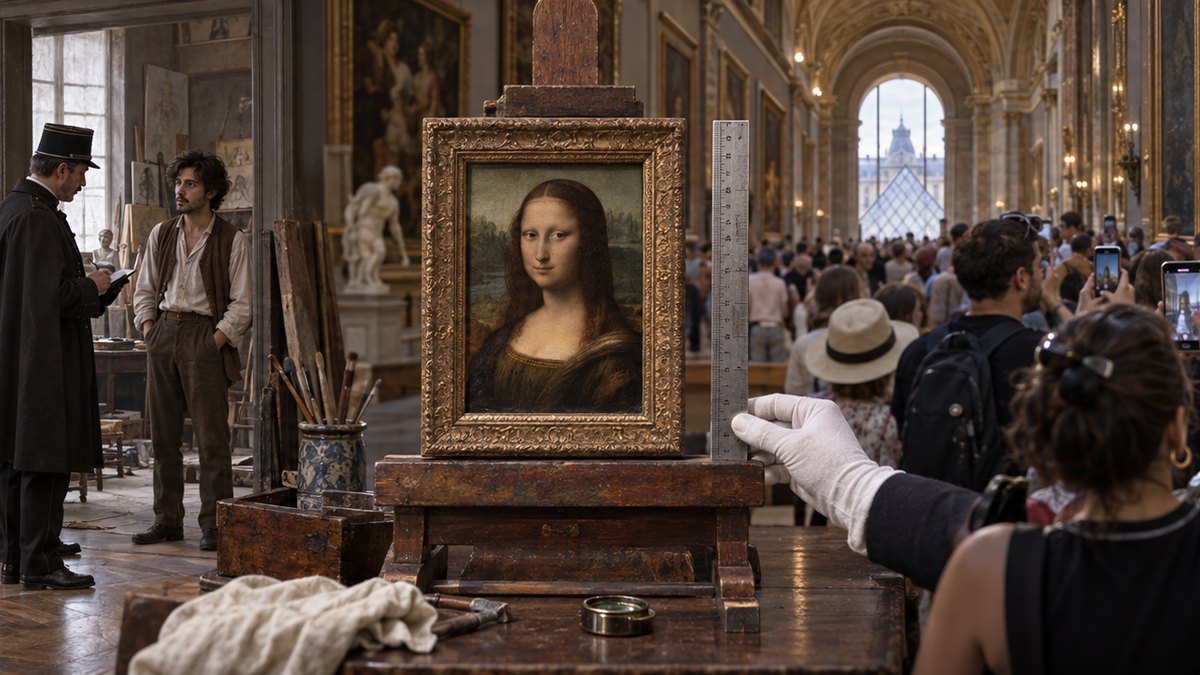
The Louvre gives the panel’s dimensions as about 77 by 53 centimeters, roughly 30 by 21 inches. That is modest compared with giant history paintings elsewhere in the museum. The contrast is part of the experience. Visitors often approach expecting something monumental and instead find a portable wooden panel surrounded by security, glass, cameras, and a crowd much larger than the object itself.
The glass is there because attacks are real
The Louvre’s conservation history records damage attempts involving acid and a thrown stone in the 1950s, followed decades later by thrown objects and protest stunts. Modern protective glazing separates the panel from the room. The security can make the painting feel distant, but it exists because a fragile work on pop-culture scale attracts risks that ordinary museum objects rarely face.
Where this story comes from
The overview is covered in the Wikipedia article “Mona Lisa.” Important primary sources for the theft include the 1911 Paris police files and contemporary newspaper reports, which record the investigation as it unfolded. Leonardo’s own surviving notes do not explain the portrait for us, so much of its later fame has to be reconstructed from documents around the painting.
Why a shirt company tells this story
The Mona Lisa belongs to painters, art students, museum travelers, teachers, designers, and people fascinated by how one image becomes part of everyday culture. A shirt design can focus on Leonardo’s line work, the frame shape, the museum mystery, or a quiet embroidered portrait detail. It can be printed or embroidered on one shirt with no minimum. The story is useful because fame itself has a history, and even famous images can be looked at differently.
Watch it on YouTube: 5 Things Nobody Tells You About The Mona Lisa. Subscribe to GoatNut for the next one.
Frequently asked questions
Who stole the Mona Lisa in 1911?
Vincenzo Peruggia stole the Mona Lisa from the Louvre in August 1911. The painting remained missing for more than two years before it was recovered in Florence in 1913.
Why is the Mona Lisa so famous?
Its fame comes from Leonardo da Vinci’s reputation, the painting’s unusual technique and expression, centuries of art criticism, the dramatic 1911 theft, mass media, reproduction, and modern tourism.
How big is the Mona Lisa?
The painted panel is about 77 centimeters tall and 53 centimeters wide, or roughly 30 by 21 inches. It is much smaller than many visitors expect.
Or start with the art: free AI design tool + all free tools →