 Your design here
Design it right now
Classic Tee — with YOUR design on it
Upload art, type text, or let the AI design it — live preview, no minimums, pay over time, ships in 5–9 days.
Split eligible US orders into 4 interest-free payments with Shop Pay
🎨 Put my design on this →Gildan 5000 · 100% cotton · 5.0–5.3 oz/yd² (170-180 g/m²) · blank sourced from Honduras · printed in the USA network · ships 5–9 days
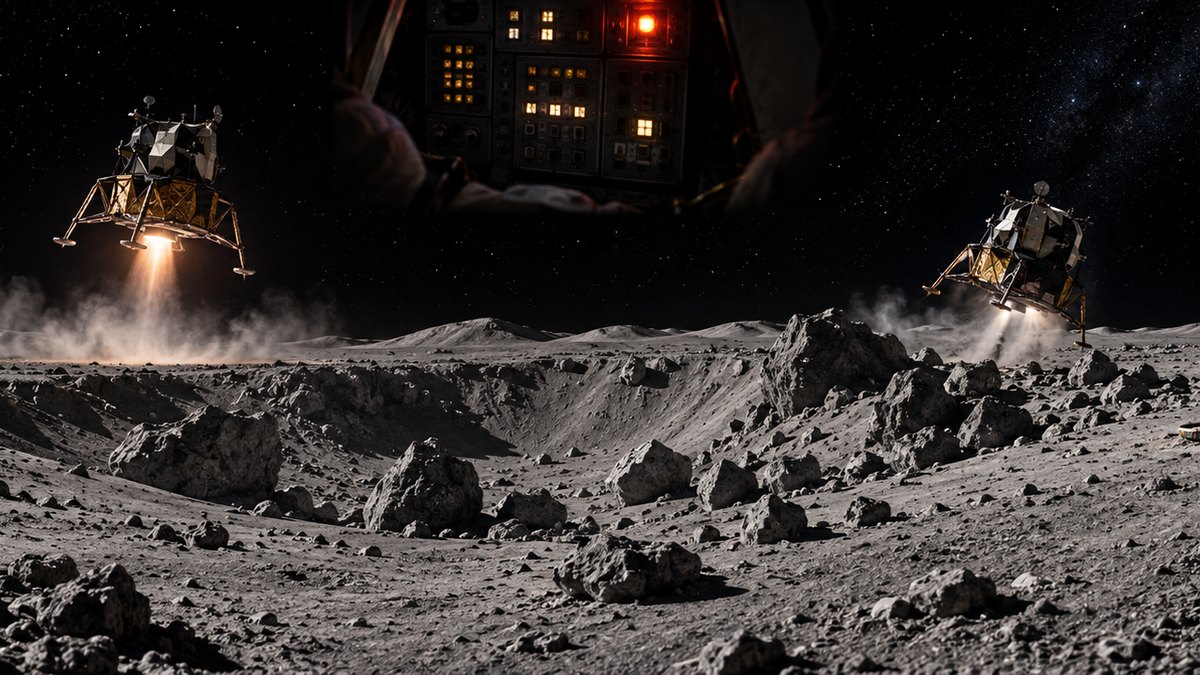
Apollo 11’s landing is remembered as calm, precise, and inevitable. Inside the Lunar Module and Mission Control, it was anything but. Computer alarms appeared during descent, the planned landing area turned ugly, fuel ran low, and Neil Armstrong had to make decisions faster than history books make them sound.
The five things
The computer alarms came during the worst possible moment
NASA’s Apollo records show that the Lunar Module computer displayed 1202 and 1201 alarms during the powered descent. The astronauts did not have time to diagnose software behavior while falling toward the Moon. Mission Control relied on guidance specialists who had studied the alarm codes in simulations and knew the computer could safely continue if the warnings did not repeat too rapidly.
Jack Garman helped recognize what the alarms meant
NASA oral histories credit 24-year-old computer engineer Jack Garman with keeping a handwritten list of unusual computer alarms near his console. He recognized the 1201 and 1202 codes as executive-overflow warnings and helped guidance officer Steve Bales decide that the landing could continue. The computer was overloaded, but its priority system was dropping lower-priority work while preserving guidance and control tasks.
Armstrong flew past the planned touchdown area
The Lunar and Planetary Institute notes that the automatic guidance was carrying Eagle toward a rough area near West Crater covered with rocks and boulders. Armstrong took more manual control and flew horizontally while looking for a safer patch. That decision used extra propellant, but it avoided setting the lander down where a large rock, steep slope, or crater edge could threaten the landing.
The fuel margin was tiny, but not exactly 20 seconds
Mission Control called “30 seconds” just before touchdown, and early NASA summaries often said less than 30 seconds of fuel remained. Post-mission analysis was more precise. NASA’s Lunar Surface Journal says Eagle actually had about 45 seconds of usable descent fuel left, while the formal mission report calculated about 50 seconds to oxidizer depletion. Either way, Apollo 11 had the smallest landing fuel margin of the Apollo missions.
The first lunar meal included bacon squares
After landing, Armstrong and Buzz Aldrin had hours of work before sleeping or walking outside. NASA meal records show that their first meal on the lunar surface included bacon squares, peaches, sugar cookie cubes, a pineapple-grapefruit drink, and coffee. Space food was designed around weight, storage, crumbs, and preparation, but this particular menu sounds surprisingly recognizable for the first dinner ever eaten on another world.
Where this story comes from
The overview appears in the Wikipedia article “Apollo 11.” The most important primary source is NASA’s Apollo 11 Mission Report, published after the flight using spacecraft data, crew debriefings, and engineering analysis. The Apollo 11 Lunar Surface Journal also preserves the mission audio and transcripts, including the computer alarms, fuel calls, and Armstrong’s descriptions during the final descent.
Why a shirt company tells this story
Apollo 11 belongs to engineers, pilots, programmers, science teachers, space collectors, and anyone who grew up looking at the Moon differently because people once landed there. A design might use Eagle’s outline, a guidance-computer display, a landing trajectory, or a small lunar coordinate graphic. It can be printed or embroidered on one shirt with no minimum. Wearing the mission can celebrate the people behind the famous footprint, including the young engineers whose names rarely appear beside it.
Watch it on YouTube: 5 Things Nobody Tells You About The Moon Landing. Subscribe to GoatNut for the next one.
Frequently asked questions
What did the 1201 and 1202 Apollo 11 alarms mean?
They were executive-overflow alarms showing that the guidance computer was receiving more work than it could process normally. Its software restarted while preserving critical guidance tasks and dropping lower-priority work.
How much fuel did Apollo 11 actually have left?
Mission Control believed the margin was extremely small. Post-flight NASA analysis found roughly 45 to 50 seconds of descent propellant remained, rather than the roughly 20 seconds sometimes repeated in popular accounts.
What was the first meal eaten on the Moon?
NASA records show the first lunar-surface meal included bacon squares, peaches, sugar cookie cubes, pineapple-grapefruit drink, and coffee. Armstrong and Aldrin ate inside the Lunar Module before their historic moonwalk.
Or start with the art: free AI design tool + all free tools →