 Your design here
Design it right now
Classic Tee — with YOUR design on it
Upload art, type text, or let the AI design it — live preview, no minimums, pay over time, ships in 5–9 days.
Split eligible US orders into 4 interest-free payments with Shop Pay
🎨 Put my design on this →Gildan 5000 · 100% cotton · 5.0–5.3 oz/yd² (170-180 g/m²) · blank sourced from Honduras · printed in the USA network · ships 5–9 days
The Great Pyramid is so old that later ancient Egyptians already lived in its shadow. The closer archaeologists get to the workers and paperwork behind it, the less it looks like a mystery dropped into the desert and the more it looks like a huge organized state project.
The five things
The workers left behind a real community
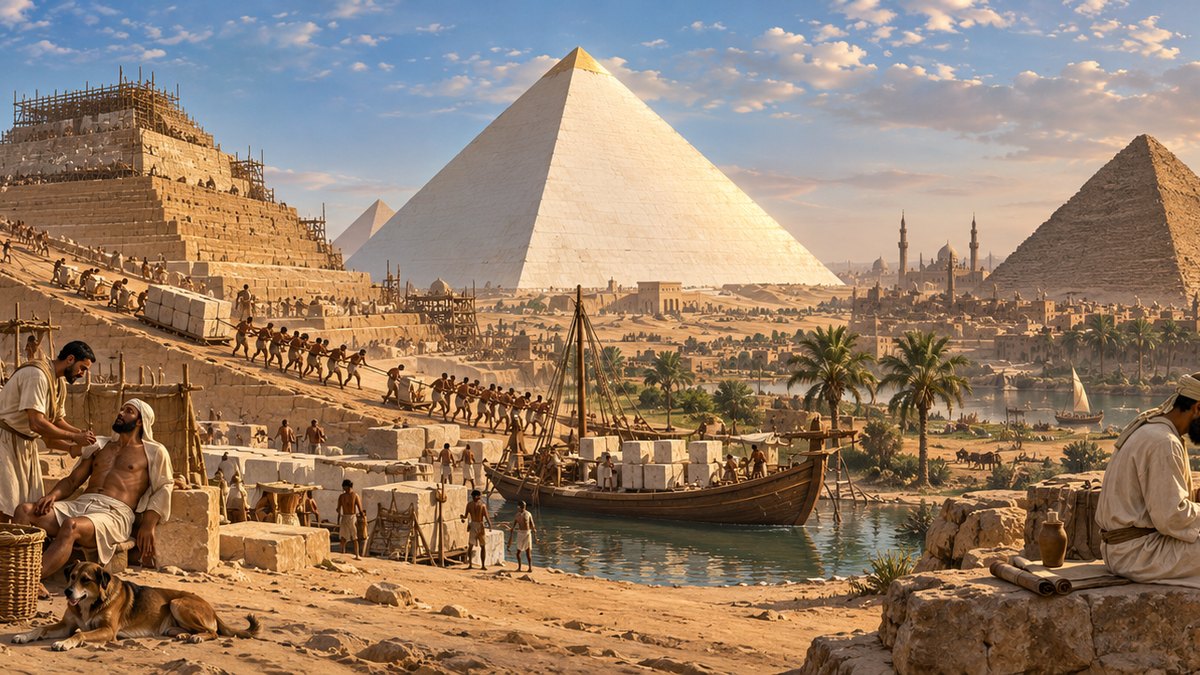
Archaeologists working at Giza have found a workers’ settlement with bakeries, food remains, sleeping areas, and administrative spaces. According to Egyptologist Mark Lehner’s Giza research, crews were supported on a large scale with bread, meat, and other provisions. That evidence does not fit the old movie image of endless chained slaves being whipped beneath the pyramids.
Its height record lasted into the medieval world
According to Encyclopaedia Britannica, the Great Pyramid originally stood about 146.6 meters, or 481 feet, tall. It remained the tallest human-made structure for roughly 3,800 years. That means its record lasted far longer than the entire history of modern skyscrapers. The pyramid people see today is shorter because the top and much of the smooth outer casing are gone.
The white outer skin changed the whole appearance
The Egyptian Ministry of Tourism and Antiquities describes the Great Pyramid as originally covered with fine white Tura limestone casing. Those blocks were carefully fitted around a rougher core. A few casing stones survive near the base, giving a clue to the original finish. In bright sun, the monument would have looked sharper, smoother, and much lighter than the stepped stone surface seen today.
Cleopatra belongs to a much later Egypt
Cleopatra VII ruled in the first century BC, while Khufu’s Great Pyramid was built around the twenty-sixth century BC. The Metropolitan Museum of Art’s Egyptian chronology makes the scale clear: more than two thousand years separate them. Cleopatra is closer to the modern era than she was to the pyramid builders, a useful reminder that “ancient Egypt” covers an enormous span of time.
The builders left us a logistics diary
The Diary of Merer records a foreman and his crew moving limestone from Tura toward Akhet-Khufu, the ancient name for the Great Pyramid complex. National Geographic notes that the papyri describe repeated boat journeys and work schedules. The diary does not explain the final lifting system, but it gives something almost better: ordinary notes from people doing the job.
Where this story comes from
The main overview appears in the Wikipedia article “Great Pyramid of Giza.” The key primary source is the Diary of Merer, part of the Wadi al-Jarf papyri. Written during Khufu’s reign, it records daily work, transport, food, and movement of limestone connected with the royal building project at Giza.
Why a shirt company tells this story
The pyramids belong to archaeologists, engineers, travelers, teachers, architecture fans, and anyone who has ever stared at a photograph and wondered how people organized something so large. That interest can become a clean line drawing, a crew mark, a geometric pattern, or a small embroidered pyramid. It can be printed or embroidered on one shirt with no minimum. Wearing history does not require pretending every unanswered question is a secret.
Watch it on YouTube: 5 Things Nobody Tells You About The Pyramids. Subscribe to GoatNut for the next one.
Frequently asked questions
Were the pyramids built by slaves?
Evidence from Giza points to organized labor crews who were housed, fed, and supported near the construction site. The old image of huge gangs of chained slaves is not supported by the main archaeological evidence.
How was the Great Pyramid built?
No single surviving document explains every construction step. Archaeologists have strong evidence for quarrying, transport, ramps, organized crews, and boat delivery, but the exact lifting system used at every stage remains debated.
What is the Diary of Merer?
The Diary of Merer is a set of ancient Egyptian papyri recording a work crew during Khufu’s reign. It describes transporting limestone by boat to the Great Pyramid complex at Giza.
Or start with the art: free AI design tool + all free tools →