 Your design here
Design it right now
Classic Tee — with YOUR design on it
Upload art, type text, or let the AI design it — live preview, no minimums, pay over time, ships in 5–9 days.
Split eligible US orders into 4 interest-free payments with Shop Pay
🎨 Put my design on this →Gildan 5000 · 100% cotton · 5.0–5.3 oz/yd² (170-180 g/m²) · blank sourced from Honduras · printed in the USA network · ships 5–9 days
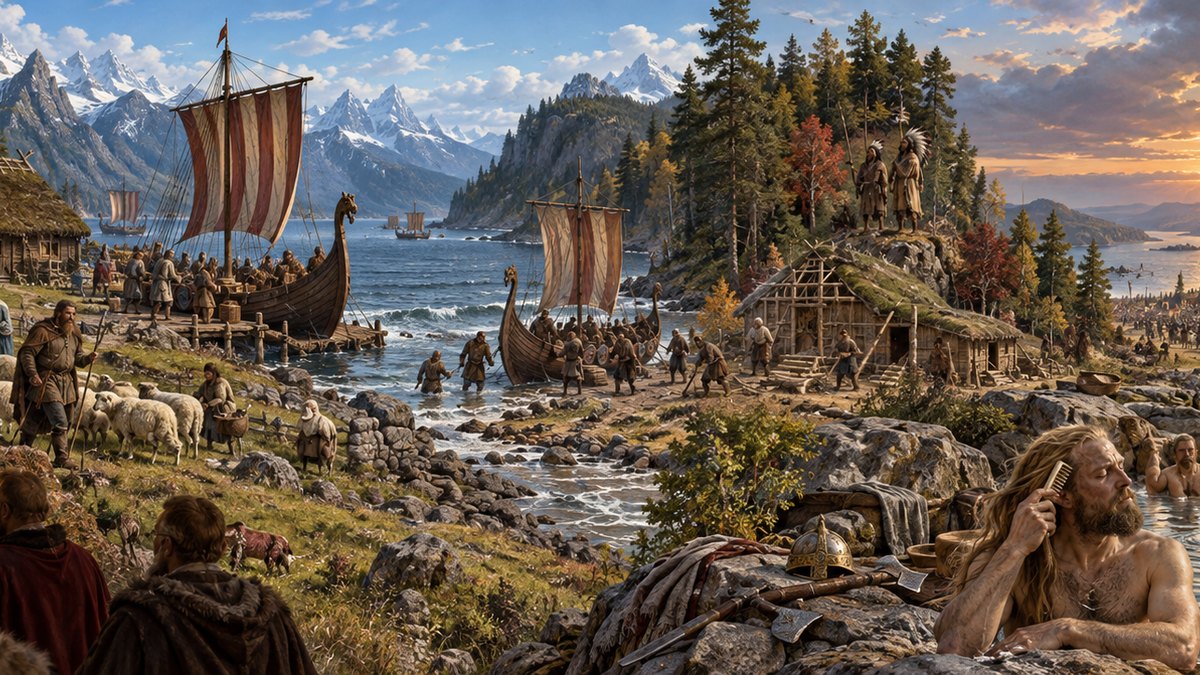
The word Viking creates an instant picture: horned helmets, longships, axes, and raids. Most of that picture leaves out the ordinary farms, trade, grooming tools, family settlements, and long afterlife of Scandinavian migration.
The five things
The horned helmet is a modern costume
No confirmed Viking Age combat helmet has the giant horns familiar from cartoons. The National Museum of Denmark notes that horned headgear belongs to much earlier Scandinavian ritual imagery, not normal Viking warfare. The modern visual stereotype grew through nineteenth-century art and stage costume, especially productions connected with Wagner, because horns made characters look ancient and dramatic from the back of a theater.
Most Scandinavian lives happened on farms
The National Museum of Denmark describes farming as the basis of everyday Viking Age life. Families raised cattle, sheep, goats, and pigs, and grew crops suited to northern climates. Raiding and long-distance sailing mattered, but they involved only part of society. The word “Viking” is therefore more useful for a kind of seafaring activity than as a label for every person who lived in Scandinavia.
North America was not just a saga
Archaeology at L’Anse aux Meadows in Newfoundland proved that Norse travelers reached North America around the year 1000. Parks Canada identifies the site as the remains of an eleventh-century Norse settlement with turf buildings and evidence of ironworking. It was not a giant colony, but it turned a story once known mainly from medieval sagas into a physical archaeological fact.
Grooming tools show up in graves and towns
The Viking Ship Museum in Denmark notes finds of combs, tweezers, ear picks, toothpicks, and other personal-care tools. These objects appear in both settlements and burials. A later English chronicle complained that Scandinavians combed their hair and washed regularly. The complaint was hardly neutral, but the archaeology supports the larger point that appearance and grooming mattered in Norse society.
Normandy carried the Viking story forward
The descendants of Scandinavian settlers in northern France became the Normans, a name that itself grew from “Northmen.” By 1066, William the Conqueror led a Norman army across the English Channel and defeated Harold at Hastings. The Bayeux Tapestry records that conquest visually. The people involved were no longer Viking raiders in the old sense, but Scandinavian migration had helped create their political world.
Where this story comes from
The overview appears in the Wikipedia article “Vikings.” One important primary written source is Ahmad ibn Fadlan’s tenth-century account of people he called Rus, Scandinavian traders and travelers he encountered near the Volga. His description is an outsider’s view and cannot represent every Viking community, but it preserves rare eyewitness detail about clothing, washing, trade, and ritual.
Why a shirt company tells this story
Viking history appeals to sailors, reenactors, teachers, medieval-history readers, Scandinavian families, gamers, and travelers who want something deeper than a horned-helmet joke. A design can use a longship line, knotwork, a real helmet shape, runic-inspired geometry, or a map of a voyage. It can be printed or embroidered on one shirt with no minimum. Wearing the subject is more interesting when the image is based on what people actually did.
Watch it on YouTube: 5 Things Nobody Tells You About The Vikings. Subscribe to GoatNut for the next one.
Frequently asked questions
Did Vikings really wear horned helmets?
There is no good evidence that Viking warriors normally wore horned helmets. The familiar horned image became popular much later through nineteenth-century art, costume design, and opera.
Were most Vikings actually farmers?
Most people in Viking Age Scandinavia lived from farming, fishing, craft work, and trade. Raiding was important, but it was only one activity within a much larger society.
Did Vikings reach America before Columbus?
Yes. Archaeological remains at L’Anse aux Meadows in Newfoundland show that Norse travelers established a settlement in North America around the year 1000, nearly five centuries before Columbus.
Or start with the art: free AI design tool + all free tools →