 Your design here
Design it right now
Classic Tee — with YOUR design on it
Upload art, type text, or let the AI design it — live preview, no minimums, pay over time, ships in 5–9 days.
Split eligible US orders into 4 interest-free payments with Shop Pay
🎨 Put my design on this →Gildan 5000 · 100% cotton · 5.0–5.3 oz/yd² (170-180 g/m²) · blank sourced from Honduras · printed in the USA network · ships 5–9 days
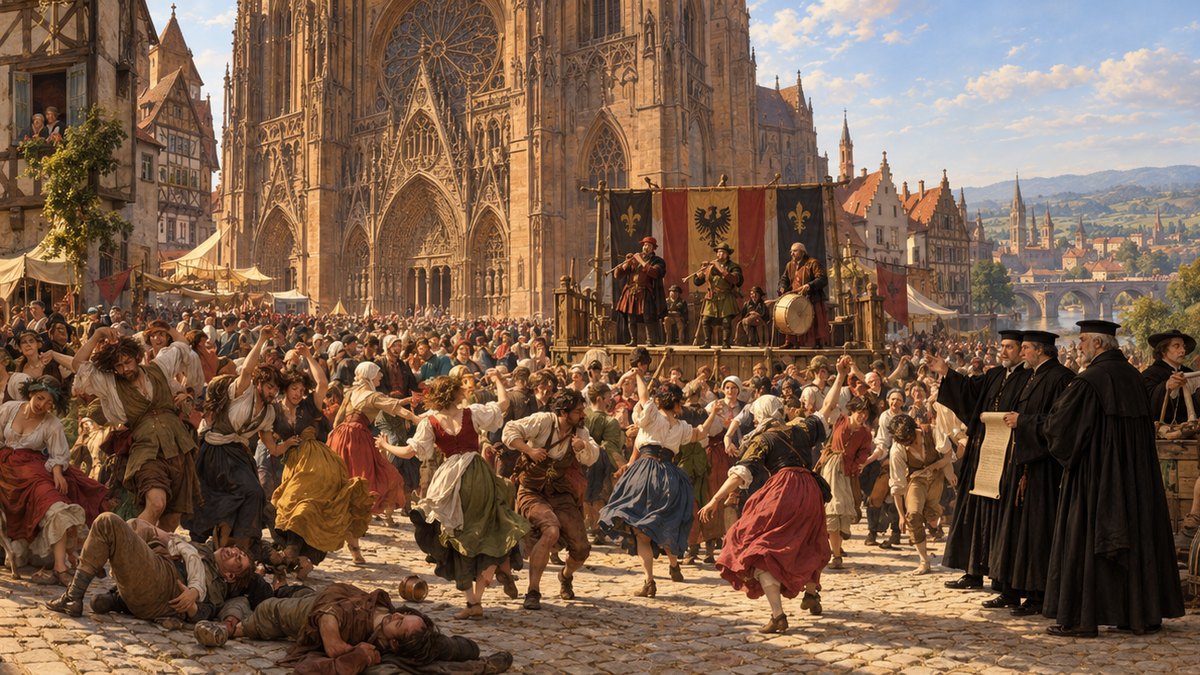
In the summer of 1518, people in Strasbourg began dancing when no celebration was taking place. The strangest part was not only that the dancing spread. City officials listened to doctors who believed the cure was to help the sufferers dance even more.
What the video covers
It appears to have started with one woman
Historian John Waller's study of the surviving chronicles identifies the first dancer as Frau Troffea. Later accounts say she danced for days before being sent toward a shrine of Saint Vitus near Saverne. Other residents began dancing while she was gone. Some chronicles report about 34 sufferers within several days, although exact numbers differ because the surviving sources were written and copied at different times.
The city treated it as a medical problem first
According to Waller's research into Strasbourg's records, physicians blamed the outbreak on overheated or “hot” blood, an idea rooted in humoral medicine. Officials were advised that sufferers should continue moving until the illness worked itself out. This diagnosis made sense within sixteenth-century medicine, even though encouraging exhausted people to keep dancing looks dangerous from a modern medical perspective.
Officials actually hired musicians
Historical research published in Dance Research describes Strasbourg authorities creating spaces where sufferers could continue dancing. Guild halls were used, platforms were arranged in public markets, and musicians and healthy dancers were hired. Rather than reducing the outbreak, the policy appeared to coincide with more cases. Some later chronicles claimed hundreds became involved, though the famous figure of 400 should be treated as an estimate rather than a precise count.
The city eventually reversed the treatment
John Waller notes that officials later restricted public music and dancing and turned toward a religious response. Sufferers were taken to a shrine dedicated to Saint Vitus near Saverne, where rituals included special shoes, crosses, prayers, and movement around an image of the saint. The outbreak then faded during the following weeks. That timing does not prove the religious treatment caused the recovery.
No explanation has won complete agreement
Ergot poisoning from contaminated grain is often mentioned, but Waller argues that poisoning does not fit prolonged, coordinated dancing very well. His preferred explanation is a mass psychogenic illness developing under extreme social stress, including hunger, disease, religious fear, and hardship. Other scholars continue debating the episode. Even the number of deaths is uncertain, despite later stories of dancers collapsing and dying.
Where this story comes from
The broad event appears in the Wikipedia article “Dancing plague of 1518.” Primary evidence includes Strasbourg City Council records and notes associated with contemporary city official Sebastian Brant. Later chroniclers such as Daniel Specklin preserved additional details from local records. Historian John Waller compared these materials to reconstruct what happened while separating contemporary evidence from details added much later.
Why a shirt company tells this story
The dancing plague belongs to history teachers, dancers, medical students, psychologists, travelers, folklore readers, and anyone interested in moments when an entire community behaves in ways that are difficult to explain. A design might use a medieval dancer, the Strasbourg skyline, a Saint Vitus motif, or a strange empty stage. It can be printed or embroidered on one shirt with no minimum. The story works because history sometimes leaves us with evidence, several theories, and no final answer.
Watch it on YouTube: In 1518 A City Danced For Two Months. The Cure Was A Band. Subscribe to GoatNut for the next one.
Frequently asked questions
Was the dancing plague of 1518 real?
Yes. An unusual outbreak of compulsive dancing in Strasbourg is documented in chronicles, medical discussion, sermons, and municipal records. The precise number of participants and deaths is less certain than the basic event.
What caused the dancing plague of Strasbourg?
Nobody knows for certain. Mass psychogenic illness under severe social stress is a leading modern explanation. Ergot poisoning and religious interpretations have also been proposed, but each has problems.
Did Strasbourg hire musicians to cure the dancers?
Historical sources indicate that officials provided dancing spaces and hired musicians because physicians believed continued movement would cure the condition. The policy failed, and authorities later restricted music and turned toward religious treatment.
Or start with the art: free AI design tool + all free tools →