 Your design here
Design it right now
Classic Tee — with YOUR design on it
Upload art, type text, or let the AI design it — live preview, no minimums, pay over time, ships in 5–9 days.
Split eligible US orders into 4 interest-free payments with Shop Pay
🎨 Put my design on this →Gildan 5000 · 100% cotton · 5.0–5.3 oz/yd² (170-180 g/m²) · blank sourced from Honduras · printed in the USA network · ships 5–9 days
Long before video games, Nintendo sold cards. Fusajiro Yamauchi began making hanafuda in Kyoto in 1889, and for generations the company’s future was paper, ink, gambling games, and family entertainment. The road from flowers on cards to electronic characters took almost a century.
What the video covers
Nintendo began with hanafuda in Kyoto
Nintendo’s official corporate history says Fusajiro Yamauchi began manufacturing and selling hanafuda playing cards in Kyoto in 1889. Hanafuda had grown out of centuries of Japanese attempts to regulate playing cards and gambling. By the late nineteenth century, manufacturing and selling cards had become legal under government rules, creating an opening for craftsmen like Yamauchi to build a legitimate card business.
Playing cards remained the core business for decades
Nintendo’s own timeline shows how slowly the transformation happened. It expanded into Western-style cards in 1902 and became the first Japanese company to mass-produce plastic playing cards in 1953. A 1959 licensing deal put familiar characters on cards aimed at families. That mattered because Nintendo was learning to sell games as broad entertainment rather than products associated mainly with traditional adult card play.
The company experimented far beyond cards
Video game historian Matt Alt, speaking with the Video Game History Foundation, describes 1960s Nintendo as a company searching for a new direction. Secondary histories document ventures connected with taxis, packaged foods, and other businesses, although some famous stories from this period are better documented than others. The important point is that Nintendo did not move directly from hanafuda to consoles. It tried different markets while looking for growth.
Gunpei Yokoi helped turn a factory idea into a toy
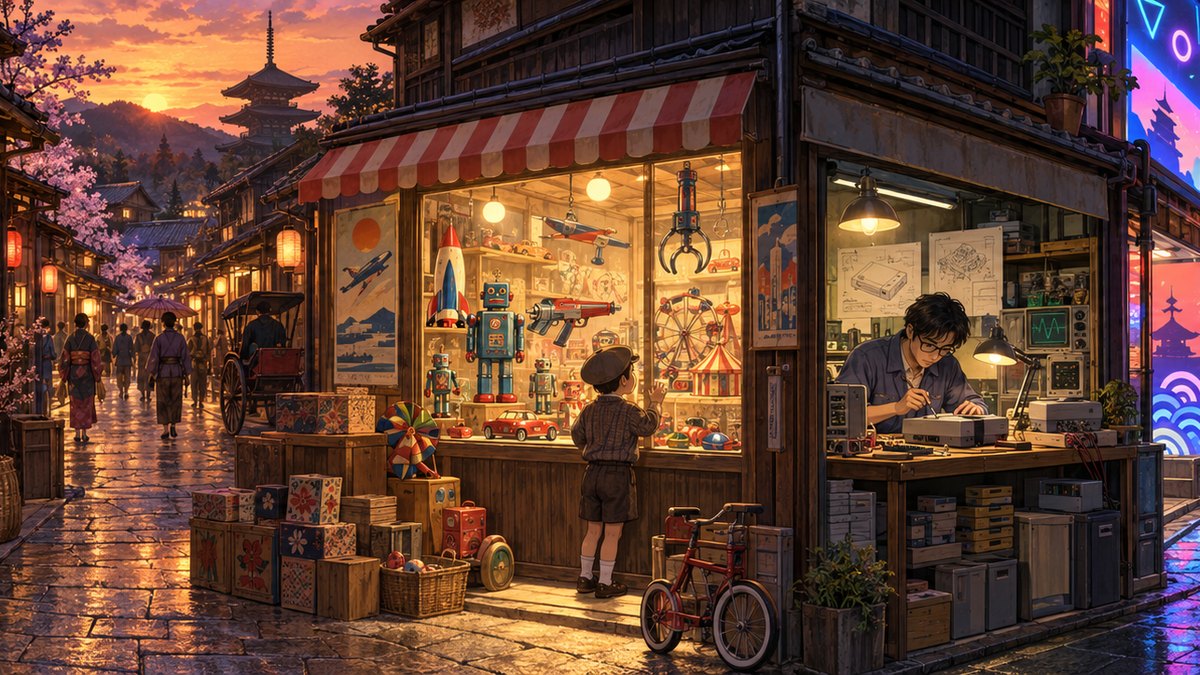
Gunpei Yokoi joined Nintendo as an engineer and became one of the key figures in its move into toys. Game historians describe company president Hiroshi Yamauchi noticing an extending arm Yokoi had made and asking him to develop it commercially. The Ultra Hand became a major toy success. Nintendo’s own museum still celebrates it today, alongside other mechanical products from the company’s pre-video-game period.
The card company never completely stopped being a card company
Nintendo moved into electronic games during the 1970s, followed by arcade products, Game & Watch, home consoles, and some of the most recognizable characters in entertainment. Yet the old business did not vanish. Nintendo’s Japanese product catalog still includes traditional hanafuda and other playing cards. The company that built electronic worlds continues selling the same general kind of product that began its story in Kyoto in 1889.
Where this story comes from
The broad history appears in the Wikipedia article “History of Nintendo.” A primary company source is Nintendo Co., Ltd.’s own corporate history, which records Fusajiro Yamauchi beginning hanafuda production in 1889 and traces later milestones through cards, toys, and electronic entertainment. Nintendo’s surviving cards and toys are also physical primary artifacts from different stages of that transition.
Why a shirt company tells this story
Nintendo’s history is interesting to gamers, designers, inventors, toy collectors, Japanese-history readers, artists, and anyone who has watched a small company change direction without completely abandoning its roots. A design might use hanafuda-inspired flowers, an extending mechanical arm, old card geometry, or a simple 1889 reference. It can be printed or embroidered on one shirt with no minimum. Sometimes the thing worth wearing is not just a favorite game, but the strange history of how an entire creative industry grew.
Watch it on YouTube: Nintendo Was Painting Playing Cards In 1889. Subscribe to GoatNut for the next one.
Frequently asked questions
What did Nintendo originally make?
Nintendo began in Kyoto in 1889 as a maker and seller of Japanese hanafuda playing cards. Playing cards remained central to the company for decades before toys and electronic games became more important.
Who founded Nintendo?
Fusajiro Yamauchi founded the business that became Nintendo in Kyoto, Japan, in 1889. He began by producing hanafuda, traditional Japanese flower cards used for several different card games.
Does Nintendo still make hanafuda cards?
Yes. Nintendo still lists hanafuda and other traditional games in its Japanese product catalog. Modern themed hanafuda decks have also been sold, linking the company's current characters with its original card-making business.
Or start with the art: free AI design tool + all free tools →