 Your design here
Design it right now
Classic Tee — with YOUR design on it
Upload art, type text, or let the AI design it — live preview, no minimums, pay over time, ships in 5–9 days.
Split eligible US orders into 4 interest-free payments with Shop Pay
🎨 Put my design on this →Gildan 5000 · 100% cotton · 5.0–5.3 oz/yd² (170-180 g/m²) · blank sourced from Honduras · printed in the USA network · ships 5–9 days
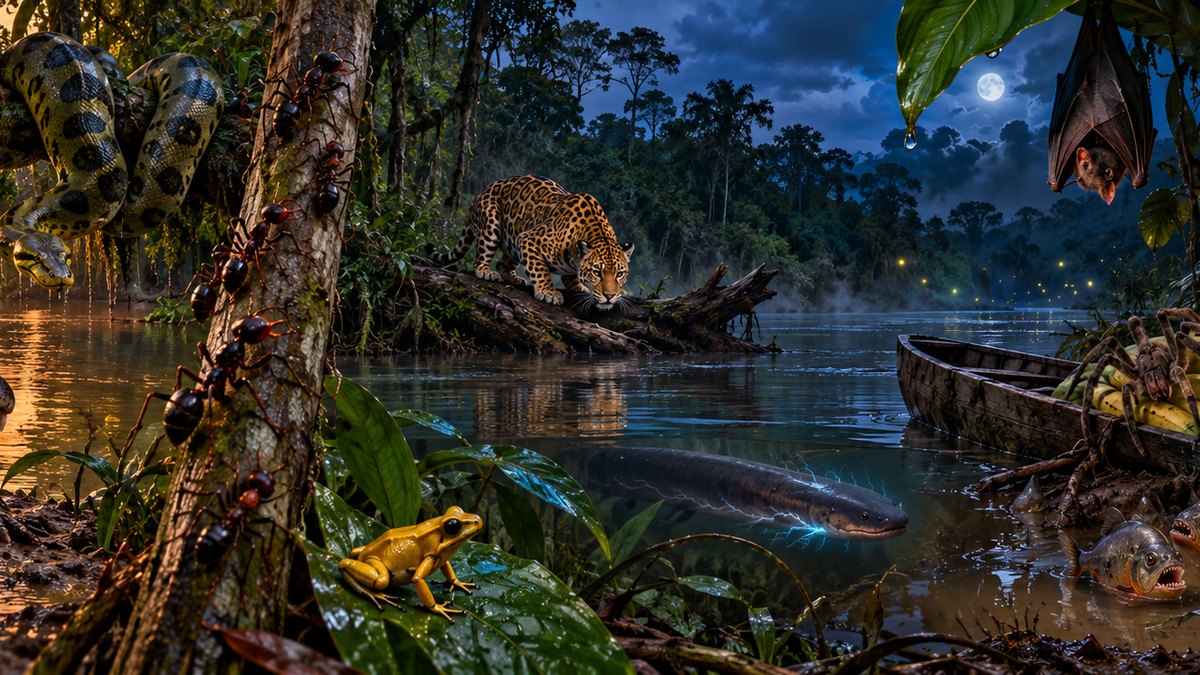
The Amazon does not need invented monsters. Its rivers and forests already contain animals built to constrict, bite, sting, shock, hunt, and spread disease. The surprising part is that several of the animals with the worst reputations are less dangerous to people than the stories suggest.
What the video covers
Black caimans and anacondas dominate the water
Animal Diversity Web describes the black caiman as the Amazon’s largest predator, with exceptional males capable of exceeding six meters. Green anacondas are among the world’s heaviest living snakes. The Smithsonian’s National Zoo says large females can reach extraordinary weights and spend much of their lives in water. Anacondas seize prey with the mouth before killing mainly by constriction, not by crushing bones.
Jaguars and bullet ants attack in very different ways
Jaguars have unusually powerful jaws for a cat and can tackle armored prey such as turtles and caimans, but the claim that they are the only big cats to kill with skull bites is too absolute. Bullet ants deliver a different warning. The Natural History Museum places their sting at level four on Justin Schmidt’s sting-pain index, with intense pain that can continue for many hours.
Poison frogs and electric eels come with important corrections
The Smithsonian says poison frogs obtain many of their skin toxins from their natural diet, which is why captive frogs often lose much of their toxicity. Not every poison frog is equally dangerous, and the famously toxic golden poison frog lives in western Colombia rather than the Amazon Basin. Electric eels are genuinely extreme. Smithsonian keepers report discharges around 600 volts in some species, with others measured as high as 860 volts.
Wandering spiders and piranhas are frightening but often exaggerated
The Natural History Museum says Brazilian wandering spiders have medically important venom and sometimes shelter around banana plants, yet fatal human bites are now rare and the spiders generally bite defensively. Piranhas are also misunderstood. Smithsonian research notes that most people swim safely in waters containing them. Risk rises in certain situations, including low water, food scarcity, disturbance of nests, or handling captured fish.
Vampire bats matter, but mosquitoes are the bigger threat
Vampire bats make small cuts and feed on blood rather than dramatically draining an animal. Their serious human risk is rabies. The CDC has documented vampire-bat rabies exposure in Amazon communities in Peru. Mosquitoes are far more dangerous on a population level. The CDC calls mosquitoes the world’s deadliest animal because they transmit diseases including malaria, dengue, yellow fever, and other infections.
Where this story comes from
The broader ecosystem is described in the Wikipedia article “Amazon rainforest.” Individual species are better checked through zoological sources because popular danger lists often exaggerate them. One primary scientific example is Kenneth Catania’s experimental work on electric eels, which documented how eels can partly emerge from water and deliver defensive electrical discharges to a perceived threat.
Why a shirt company tells this story
Amazon wildlife belongs to biologists, travelers, reptile keepers, birders, conservation students, anglers, and people who simply love animals that look stranger than fiction. A design might use a jaguar pattern, anaconda silhouette, electric eel waveform, caiman eye, or tiny mosquito graphic. It can be printed or embroidered on one shirt with no minimum. Wearing the animals you care about can also be a reason to learn what they actually do instead of repeating the scariest version of the story.
Watch it on YouTube: The Amazon Doesn't Need Monsters. It Has These. Subscribe to GoatNut for the next one.
Frequently asked questions
What is the most dangerous animal in the Amazon?
For human health, mosquitoes are a stronger answer than jaguars, snakes, or caimans because they can transmit serious diseases. Direct attacks from large Amazon predators are much rarer than mosquito-borne illness.
Are green anacondas dangerous to humans?
Green anacondas are enormous constrictors capable of overpowering large prey, but confirmed fatal attacks on humans are exceptionally rare. They usually avoid people and spend much of their lives around slow-moving water.
Do piranhas really attack people in swarms?
The movie version is exaggerated. Human bites do occur, especially under stressful environmental conditions or when fish are handled, but people routinely enter South American waters containing piranhas without being attacked.
Or start with the art: free AI design tool + all free tools →