 Your design here
Design it right now
Classic Tee — with YOUR design on it
Upload art, type text, or let the AI design it — live preview, no minimums, pay over time, ships in 5–9 days.
Split eligible US orders into 4 interest-free payments with Shop Pay
🎨 Put my design on this →Gildan 5000 · 100% cotton · 5.0–5.3 oz/yd² (170-180 g/m²) · blank sourced from Honduras · printed in the USA network · ships 5–9 days
Kepler-452b sounds almost familiar. It circles a Sun-like star, has a year close to ours, and sits where liquid water could be possible. The problem is that almost everything beyond those basic facts is still hidden from us.
What the video covers
Kepler found it by watching a star blink
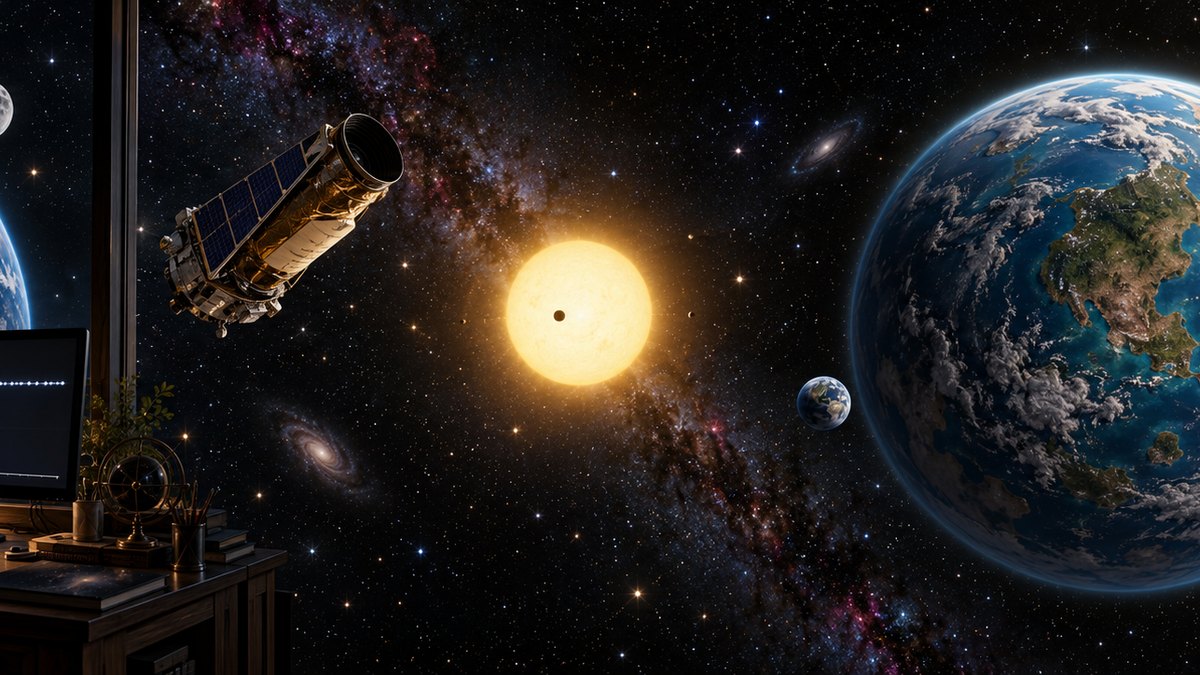
NASA announced Kepler-452b in July 2015 after scientists found repeated dips in the brightness of its star. According to the discovery team led by Jon Jenkins, Kepler recorded multiple transits spaced about 385 days apart. The planet itself was never photographed. Its existence was inferred because the same tiny fraction of starlight disappeared on a regular schedule.
Its orbit looks surprisingly familiar
According to NASA, Kepler-452b circles its star at about 1.05 astronomical units, only about five percent farther out than Earth is from the Sun. Its 385-day year is also only about five percent longer than ours. Those similarities helped make the discovery famous, although an Earth-like orbit does not automatically mean an Earth-like surface.
Its star shows us an older solar future
NASA estimates the star Kepler-452 to be about six billion years old, roughly 1.5 billion years older than our Sun. It is also about 20 percent brighter and 10 percent larger in diameter. Stellar evolution models say Sun-like stars gradually brighten as they age, so the system offers scientists an interesting comparison for thinking about Earth's distant climatic future.
The planet is bigger, but its mass is unknown
The discovery paper gives Kepler-452b a radius about 1.6 times Earth's. According to NASA, its actual mass and composition have not been measured, so descriptions of strong gravity depend on models that assume the planet is rocky. A rocky world of that size could have much stronger surface gravity, but it could instead contain large amounts of gas or volatile material.
The distance makes visiting almost unimaginable
NASA places the system about 1,400 light-years away in the constellation Cygnus. Even using the record speeds reached by modern spacecraft as a simple comparison, an interstellar journey would take millions of years. Spacecraft such as Parker Solar Probe reach their greatest speeds close to the Sun and could not simply maintain that velocity to Kepler-452b, making the real engineering problem even harder.
Where this story comes from
The broad story appears in the Wikipedia article "Kepler-452b." The key primary scientific source is Jon Jenkins and colleagues' 2015 discovery paper, "Discovery and Validation of Kepler-452b," which reports the transit measurements, stellar observations, estimated radius, orbital period, and statistical validation behind the announcement.
Why a shirt company tells this story
Kepler-452b belongs to astronomy students, science teachers, telescope owners, space fans, and anyone who likes thinking about worlds beyond our own. A design might use an orbit, a distant star, a transit curve, or an imagined rocky horizon while keeping the science clear about what we actually know. That idea can be printed or embroidered on one shirt with no minimum. Sometimes what you wear is simply a way to carry a question you love thinking about.
Watch it on YouTube: Everything We Know About The Goldilocks Planet, Earth's Cousin (Part 1). Subscribe to GoatNut for the next one.
Frequently asked questions
Is Kepler-452b really like Earth?
It shares some important features with Earth, including an orbit in its star's habitable zone and a similar year length. Its atmosphere, surface, oceans, mass, and actual habitability remain unknown.
How far away is Kepler-452b?
Kepler-452b is about 1,400 light-years from Earth in the constellation Cygnus. That means the light we detect from its system began traveling toward us roughly 1,400 years ago.
Has anyone ever photographed Kepler-452b?
No direct image of the planet exists. Kepler detected it using the transit method, which measures the tiny drop in a star's brightness when an orbiting planet crosses in front.
Or start with the art: free AI design tool + all free tools →